You’ve prepared your answers. You’ve researched the company. You’ve printed your resume. Then the night before, you open your wardrobe and freeze — what do I actually wear tomorrow?
You pick a bright red shirt. Too flashy? A casual t-shirt. Too informal? Your old college jeans. Too risky? You try 5 combinations and still aren’t sure.
This sounds silly — but your interview outfit matters more than you think. A 2025 Princeton University study found that people form judgments about competence and professionalism within 100 milliseconds of seeing someone. Before you say a single word, your outfit has already spoken for you.
In this article, I’ll give you a clear, practical dress code guide for Indian job interviews — separate sections for men and women, by industry — so you never stand in front of your wardrobe confused again.
What Colour Should You Wear to an Interview — The Psychology of Colour
Colour sends a message before you open your mouth. Some colours project confidence. Others project confusion.
| Colour | Message It Sends | Interview Suitability |
|---|---|---|
| White | Clean, professional, trustworthy | ✅ Best — works everywhere |
| Light blue | Calm, reliable, approachable | ✅ Excellent — universally safe |
| Grey | Sophisticated, mature, balanced | ✅ Very good — for trousers and blazers |
| Navy blue | Authoritative, serious, competent | ✅ Very good — strong first impression |
| Beige / Cream | Warm, approachable, professional | ✅ Good — especially for women |
| Black | Powerful, formal, sharp | ✅ Good — for trousers, blazers, not shirts |
| Pastel shades | Soft, professional, pleasant | ✅ Good — for women’s tops and kurtas |
| Bright red | Aggressive, dominant | ⚠️ Risky — can feel too bold |
| Bright yellow / orange | Casual, loud | ❌ Avoid — too informal |
| Neon / flashy prints | Distracting, unprofessional | ❌ Avoid — always |
The safest combination for any interview in India: White or light blue shirt/top + dark trousers (navy, grey, or black). This works across every industry — IT, banking, government, startup, everything.
A fresher in Hyderabad wore a bright yellow printed shirt to a bank interview. The interview went well — his answers were good. But the feedback from the panel was — “Good knowledge, but didn’t appear professional.” He lost the offer to a candidate who answered similarly but looked the part. He wore a white formal shirt to his next interview. He got hired.
According to a 2024 CareerBuilder India survey, 65% of recruiters said outfit colour influences their perception of a candidate’s professionalism. It doesn’t determine the final decision — but it shapes the first impression that frames everything else.
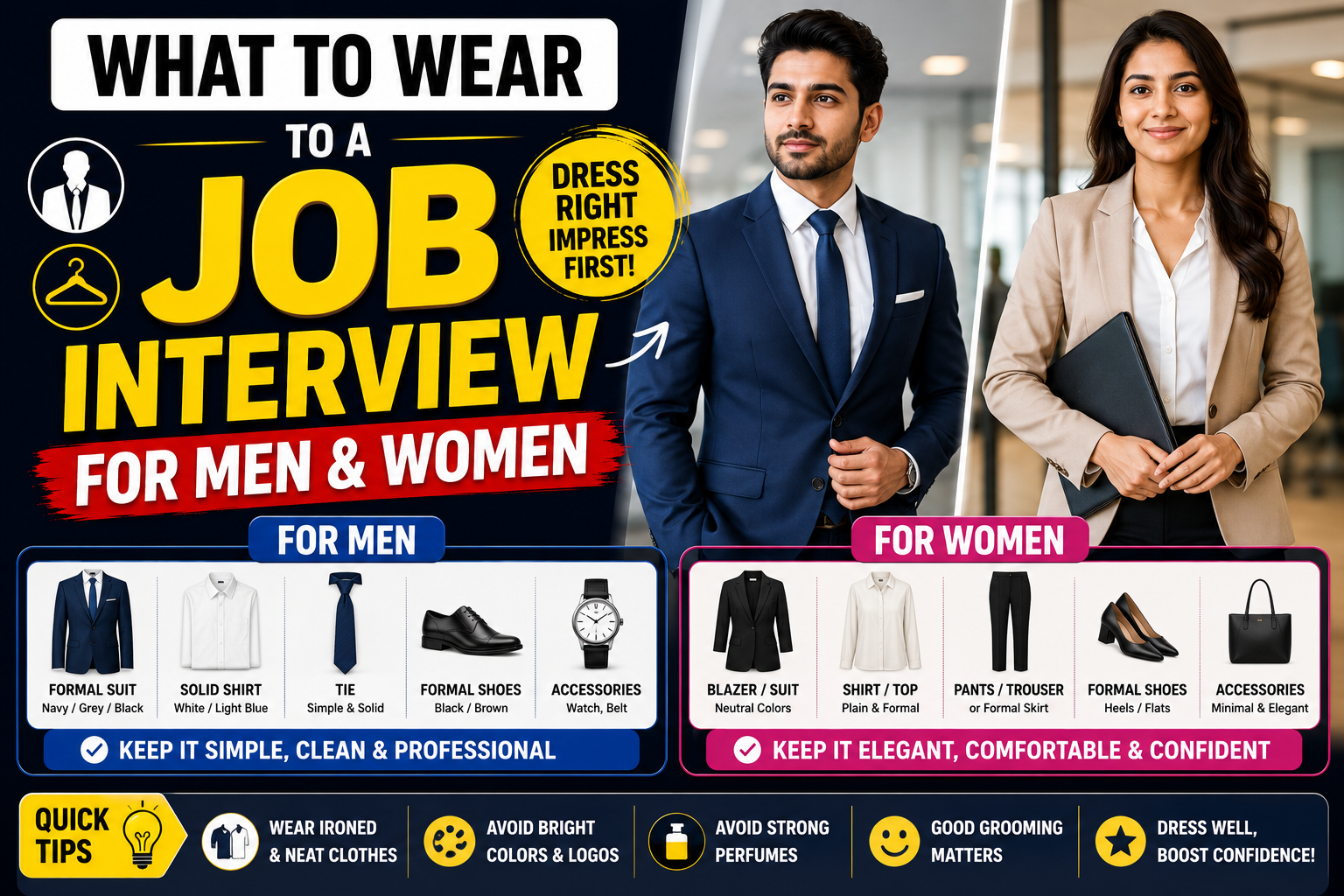
Interview Dress Code for Men in India — Complete Guide
Corporate / MNC Interview
| Item | Recommendation |
|---|---|
| Shirt | Full-sleeve formal shirt — white, light blue, or pale grey |
| Trousers | Dark formal trousers — navy, charcoal, or black |
| Shoes | Black or brown leather formal shoes — polished and clean |
| Belt | Leather belt matching shoe colour |
| Tie | Optional in most Indian companies. Wear only if the company culture is very formal (banking, consulting) |
| Watch | Simple, professional — no flashy or sports watches |
| Socks | Dark solid colour — matching trousers |
Startup Interview
Startups are more relaxed — but “casual” doesn’t mean sloppy.
- Clean collared polo shirt or well-fitted casual shirt
- Dark chinos or clean jeans (no ripped, faded, or distressed)
- Clean sneakers or loafers — no flip-flops
- No tie needed
Bank / Government Interview
Conservative and formal — no shortcuts.
- Full-sleeve white or light-coloured formal shirt
- Dark trousers — black or navy only
- Black leather formal shoes — polished
- Clean-shaven or neatly trimmed beard
- Tie optional but recommended for banking interviews
Grooming checklist for men:
- Clean-shaven or well-trimmed beard — no unkempt stubble
- Hair neatly combed — no extreme hairstyles
- Nails trimmed and clean
- Light deodorant — never heavy perfume
- Fresh breath — use mouthwash before leaving
A fresher in Bangalore attended a Deloitte interview in a t-shirt and jeans because “it’s an IT company.” The other candidates wore formal shirts. He felt underdressed from the waiting room itself — and it affected his confidence throughout the interview. He didn’t get selected. When in doubt — dress one level above what you think is needed.
Interview Dress Code for Women in India — Complete Guide
Should Women Wear Saree or Western for Interview?
This is the most searched question by Indian women before interviews. The honest answer — both are perfectly acceptable. Wear what you’re comfortable in.
| Outfit Option | When to Wear | Tips |
|---|---|---|
| Salwar Suit / Churidar | Bank, government, traditional companies, teaching | Neat, pressed, solid or subtle print |
| Formal Kurta + Trousers | Any corporate or startup setting | Modern, professional, very versatile |
| Formal Western (Shirt + Trousers) | MNC, IT, startup, marketing companies | Fitted, not tight. Solid neutral colours |
| Saree | Government, PSU, banking, formal traditional settings | Cotton or silk — not heavy embroidered wedding sarees |
| Blazer + Top + Trousers | Senior roles, consulting, client-facing positions | Sharp and authoritative look |
The most versatile outfit for Indian women in 2026: A neat formal kurta with straight-fit trousers and closed shoes. This works at TCS, HDFC Bank, a Bangalore startup, and a government office — without looking out of place anywhere.
A woman in Mumbai was confused between a saree and a formal top for her ICICI Bank interview. She called her senior who worked there. The senior said — “Half the women here wear kurta-trousers, half wear sarees. Both are accepted. Wear what makes you feel confident.” She wore a simple cotton saree. She felt comfortable. She got the job.
Corporate / MNC Interview — Women
| Item | Recommendation |
|---|---|
| Top | Formal shirt, blouse, or kurta — solid or subtle print |
| Bottom | Formal trousers, straight-fit pants, or midi skirt |
| Footwear | Closed-toe flats, low heels, or formal sandals — no stilettos |
| Accessories | Minimal — small earrings, simple watch |
| Bag | Professional handbag or folder — not a backpack |
| Dupatta | Optional — neatly draped if worn |
Startup Interview — Women
- Smart casual — neat kurta, fitted top, or casual blazer
- Clean jeans or chinos with a professional top
- Minimal jewellery
- Clean flats or loafers
Grooming checklist for women:
- Neat hair — tied back or well-styled. No extreme colours for conservative industries
- Minimal makeup — foundation, light lipstick, clean brows. Not a party look
- Nails clean and trimmed — neutral polish if any
- Light perfume — never overpowering
- Fresh, clean footwear — no dusty or worn-out shoes
A recruiter at Wipro Chennai told me — “I don’t care if a woman wears a saree, kurta, or shirt. I care if the outfit is clean, ironed, and appropriate. A wrinkled kurta is worse than a simple t-shirt that’s clean and pressed. Neatness beats brand or style every time.”
What NOT to Wear — Common Outfit Mistakes
Mistake 1: Wearing jeans to a formal interview.
“Is jeans acceptable for an interview?” — only at very casual startups. For any corporate, banking, government, or MNC interview — avoid jeans entirely. Even at startups, opt for clean dark jeans only if you’re sure the culture is casual. When unsure, wear trousers. Nobody was ever rejected for being too formal.
Mistake 2: Wearing brand new shoes without breaking them in.
You buy new formal shoes the morning of the interview. By the time you reach the office, your heels are bleeding and you’re limping. Wear shoes you’ve already used at least 2-3 times. Comfort affects confidence. A candidate in Pune wore new heels to her interview and spent the entire conversation shifting uncomfortably. The interviewer noticed.
Mistake 3: Over-accessorizing.
Multiple rings, heavy bangles, chunky necklaces, large earrings — these distract the interviewer’s attention from your answers to your accessories. Keep it minimal. One watch. Small earrings. That’s enough. The focus should be on what you say — not what you’re wearing.
Mistake 4: Ignoring grooming while focusing only on clothes.
A perfectly ironed shirt with unwashed hair, dirty nails, and stained shoes sends mixed signals. Grooming is part of your outfit. A hiring manager in Gurgaon told me — “I’ve seen candidates in expensive clothes with terrible grooming. The mismatch is more noticeable than wearing a simple, clean outfit with good grooming.”
Mistake 5: Wearing heavy perfume or cologne.
What smells pleasant to you might be overwhelming to someone sitting across a desk. In a closed meeting room, strong fragrance becomes uncomfortable. Use light deodorant. If using perfume — one spray on the wrist. That’s it. Several HR professionals I spoke to mentioned that overpowering fragrance is a surprisingly common interview turnoff.
Frequently Asked Questions
Q1: What colour should I wear to an interview?
White, light blue, and grey are the safest and most universally professional. Navy blue and beige also work well. Avoid bright red, yellow, orange, and neon shades. For trousers and blazers — stick to dark colours (black, navy, charcoal). A white or light blue shirt with dark trousers works for every industry in India.
Q2: Should women wear saree or western outfits for interviews?
Both are equally acceptable. Wear what makes you comfortable and confident. Sarees work well for banking, government, and traditional companies. Formal western or kurta-trousers work for IT, startups, and MNCs. The outfit doesn’t determine selection — your comfort, neatness, and confidence do.
Q3: Is jeans acceptable for a job interview in India?
For most formal interviews — no. Stick to trousers. Jeans are only acceptable at very casual startups where the entire team wears jeans daily. If you’re unsure about the company culture, wear trousers. It’s better to be slightly overdressed than noticeably underdressed.
Q4: Does interview dress code really matter in India?
Yes. 65% of recruiters say outfit influences their perception of professionalism. It doesn’t override your skills and answers — but it shapes the first impression. Two equally qualified candidates — one neat and professionally dressed, one wrinkled and casually dressed — the first one has an advantage. Dress like you already work there.
Q5: What should you NOT wear to a job interview?
Avoid flip-flops, ripped jeans, shorts, sleeveless tops (men), heavy jewellery, graphic t-shirts, bright neon clothing, and any outfit with large logos or slogans. Avoid heavy perfume, extreme hairstyles, and anything you’d wear to a party or the beach. The goal is to look clean, professional, and appropriate for a workplace.
You Have 100 Milliseconds — Make Them Count
Here’s the final truth — you’ll spend hours preparing answers, but the interviewer’s first impression is formed before you say a single word. Your outfit talks before you do.
Open your wardrobe tonight. Pick a clean, ironed, professional outfit. White or light blue shirt. Dark trousers. Clean shoes. Minimal accessories. Good grooming.
You don’t need expensive clothes. You don’t need brands. You need clothes that are clean, pressed, well-fitted, and appropriate for the setting.
Dress like you belong there. Then prove that you do. 💪