Two candidates sit in the same interview. Both have a B.Tech from the same college. Both know Java and Python. Both scored above 8 CGPA. The interviewer asks — “Tell me about a time you disagreed with a teammate.” One candidate gives a clear, structured answer showing communication and conflict resolution. The other stares blankly and says “I usually agree with everyone.”
Guess who got hired?
The first one. Because technical skills got both of them into the interview room. But soft skills decided who walked out with the offer.
In this article, I’ll break down the real difference between hard skills and soft skills, which ones matter more in 2026, and exactly how to show both on your resume — with industry-wise examples.
Hard Skills vs Soft Skills — The Real Difference Explained Simply
Hard skills are teachable, measurable abilities. You can learn them from a course, a textbook, or on the job. Someone can test you on them. You either know Python or you don’t. You either know Tally or you don’t.
Soft skills are personal qualities that affect how you work with others. You can’t learn them from a textbook. They develop through experience, awareness, and practice. Nobody gives you a “communication skills” certificate that proves you’re a good communicator.
| Factor | Hard Skills | Soft Skills |
|---|---|---|
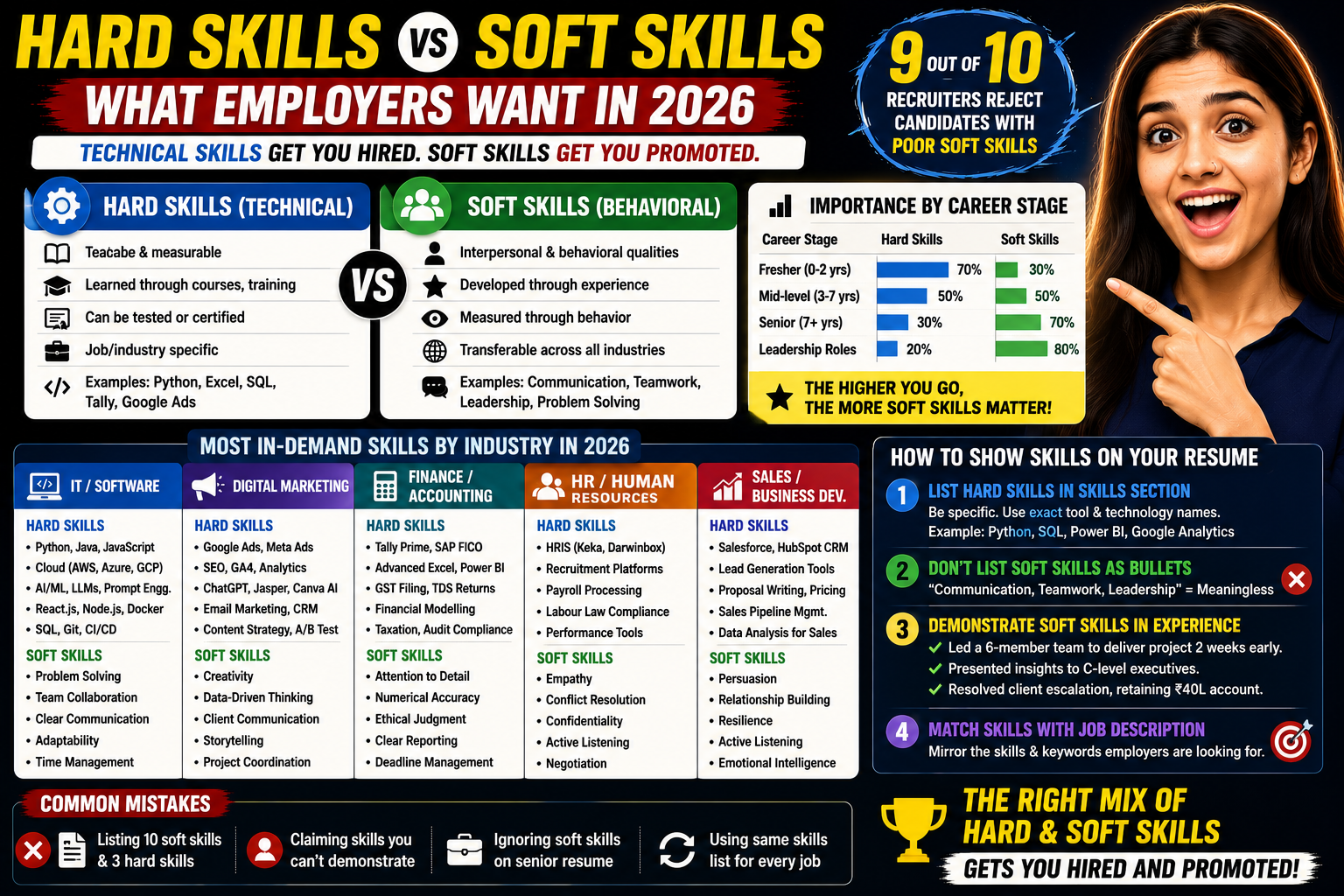
| Definition | Technical, job-specific abilities | Interpersonal, behavioural qualities |
| How learned | Courses, certifications, training | Experience, feedback, self-awareness |
| How measured | Tests, projects, certifications | Observation, interviews, behaviour |
| Transferability | Specific to role/industry | Transferable across all industries |
| Example | Python, Excel, Tally, Google Ads | Communication, teamwork, leadership |
| Resume placement | Skills section, prominently | Woven into experience descriptions |
A data analyst in Pune told me — “I got my first job because of SQL and Power BI. I got my promotion because I could explain data insights to non-technical managers in simple language.” His hard skills opened the door. His soft skill — communication — moved him up.
According to a 2026 LinkedIn India Workforce Report, 9 out of 10 recruiters say they’ve rejected candidates who had strong technical skills but poor soft skills. Hard skills get you the interview. Soft skills get you the job.
Which Is More Important — Hard Skills or Soft Skills
This is the most searched question in this category. And the honest answer is — both are essential, but the ratio changes based on your career stage.
| Career Stage | Hard Skills Importance | Soft Skills Importance |
|---|---|---|
| Fresher (0-2 years) | 70% | 30% |
| Mid-level (3-7 years) | 50% | 50% |
| Senior (7+ years) | 30% | 70% |
| Leadership/Management | 20% | 80% |
Why this shift? When you’re a fresher, employers need to know you can do the technical work. Can you code? Can you use Tally? Can you run Google Ads? Hard skills prove your capability.
But as you grow, your role shifts from doing work to leading work. Managing people, resolving conflicts, presenting to clients, making decisions under pressure — these are all soft skills. A senior manager who knows advanced Python but can’t lead a 10-person team is a bad senior manager.
A hiring director at a Bangalore IT company told me — “For junior roles, I filter by hard skills first. For team lead roles, I filter by soft skills first. A team lead who can’t communicate clearly causes more damage than one who doesn’t know the latest framework.”
2026 reality check: According to the World Economic Forum’s Future of Jobs 2025 report, the top 5 skills employers globally want are:
- Analytical thinking (soft)
- Resilience, flexibility, agility (soft)
- AI and big data (hard)
- Leadership and social influence (soft)
- Creative thinking (soft)
Four out of five are soft skills. The job market is shifting — and your resume should reflect that.
Most In-Demand Hard Skills and Soft Skills by Industry — 2026
IT / Software Development
| Hard Skills | Soft Skills |
|---|---|
| Python, Java, JavaScript | Problem solving |
| Cloud (AWS, Azure, GCP) | Team collaboration |
| AI/ML, LLMs, Prompt Engineering | Clear technical communication |
| React.js, Node.js, Docker | Adaptability to new tech |
| SQL, Git, CI/CD | Time management |
Digital Marketing
| Hard Skills | Soft Skills |
|---|---|
| Google Ads, Meta Ads | Creativity |
| SEO, Google Analytics 4 | Data-driven thinking |
| ChatGPT, Jasper, Canva AI | Client communication |
| Email marketing, CRM tools | Storytelling |
| Content strategy, A/B testing | Project coordination |
Finance / Accounting
| Hard Skills | Soft Skills |
|---|---|
| Tally Prime, SAP FICO | Attention to detail |
| Advanced Excel, Power BI | Numerical accuracy |
| GST filing, TDS returns | Ethical judgment |
| Financial modelling | Clear reporting |
| Taxation, audit compliance | Deadline management |
HR / Human Resources
| Hard Skills | Soft Skills |
|---|---|
| HRIS (Keka, Darwinbox) | Empathy |
| Recruitment platforms (Naukri RMS) | Conflict resolution |
| Payroll processing | Confidentiality |
| Labour law compliance | Active listening |
| Performance management tools | Negotiation |
Sales / Business Development
| Hard Skills | Soft Skills |
|---|---|
| Salesforce, HubSpot CRM | Persuasion |
| Lead generation tools | Relationship building |
| Proposal writing, pricing | Resilience |
| Sales pipeline management | Active listening |
| Data analysis for sales | Emotional intelligence |
A sales manager in Gurgaon had a team of 8 reps. The top performer wasn’t the one with the best product knowledge (hard skill). It was the one who built the strongest client relationships (soft skill) and handled objections calmly (emotional intelligence). His close rate was 35% — the team average was 18%. Same product. Same market. Different soft skills.
How to Show Hard Skills and Soft Skills on Your Resume — Step by Step
Step 1: List hard skills in a dedicated Skills section.
Be specific. Use exact tool and technology names. “Python, SQL, Power BI, Google Analytics” — not “computer skills, data analysis.” Hard skills need to be searchable by ATS. Vague terms don’t match.
Step 2: Don’t list soft skills as bullet points in the Skills section.
“Communication, teamwork, leadership” sitting in your skills section is meaningless. Every candidate lists them. No recruiter believes them.
Step 3: Instead — demonstrate soft skills through your experience.
❌ Wrong: Skills: Leadership, teamwork, communication
✅ Right (in Experience section):
“Led a 6-member cross-functional team to deliver the client dashboard project 2 weeks ahead of schedule.” — This shows leadership and teamwork.
“Presented monthly analytics reports to C-suite executives, simplifying technical insights into business recommendations.” — This shows communication.
“Resolved a critical client escalation involving 3 departments, retaining a ₹40 lakh annual account.” — This shows problem solving and conflict resolution.
A fresher in Chennai listed “Leadership skills” in her skills section. The recruiter ignored it. Another fresher wrote — “Led a 12-member team organizing TechFest 2025 with 400+ attendees and ₹1.5 lakh budget.” Same quality. Completely different credibility. Actions prove soft skills. Words don’t.
Step 4: Match your skills to the job description.
If the job posting emphasizes “collaboration” and “stakeholder management” — your resume should show team projects and client-facing experience. If it emphasizes “analytical thinking” — show data-driven decisions you’ve made. Read every job description. Mirror the soft skills they value.
Step 5: Prepare soft skill stories for interviews.
Your resume shows the skill. The interview proves it. For every soft skill you claim — have one 2-minute story ready. Use the STAR method — Situation, Task, Action, Result. A marketing manager in Mumbai prepared 5 STAR stories before her interview. The interviewer asked about conflict resolution, time management, and leadership. She had a story for each. She got hired over 3 other candidates with stronger technical backgrounds.
Common Mistakes When Listing Skills on a Resume
Mistake 1: Listing 10 soft skills and 3 hard skills.
“Hardworking, team player, quick learner, creative, positive attitude, strong communicator, self-motivated, detail-oriented, adaptable, honest.” This reads like a personality quiz answer — not a professional resume. Cut soft skills to 2-3 maximum and shift space to specific hard skills that ATS can match.
Mistake 2: Claiming soft skills you can’t demonstrate.
Every resume in India says “excellent communication skills.” Then the candidate struggles to explain their own project in the interview. Don’t list soft skills you can’t back up with a real example. If you’ve never led a team, don’t claim leadership. If you’ve never resolved a conflict, don’t claim conflict resolution.
Mistake 3: Ignoring soft skills entirely on a senior resume.
A 10-year experienced professional listing only technical skills is missing the point. At 7+ years, your promotions depend more on people management, strategic thinking, and communication than on coding ability. Show soft skills through achievements — “Built and mentored a team of 8 engineers” or “Managed client relationships worth ₹2 crore annually.”
Mistake 4: Using the same skills list for every application.
A developer applying for a frontend role should highlight different hard skills than one applying for a DevOps role. Similarly, a client-facing role needs different soft skills emphasized than an internal analytics role. Customize every application. 5 minutes of tailoring beats 50 generic applications.
Frequently Asked Questions
Q1: Which is more important — hard skills or soft skills?
Both are essential — the ratio depends on career stage. Freshers need 70% hard skills to prove technical ability. Mid-level professionals need 50-50. Senior professionals and leaders need 70% soft skills because their job is managing people and decisions, not just executing tasks. The higher you go, the more soft skills matter.
Q2: How to improve soft skills for a job?
Practice in real situations. Volunteer to present in meetings (communication). Lead a small project at work (leadership). Actively listen in conversations without interrupting (listening). Ask for feedback from managers and peers. Read one book on emotional intelligence or communication. Soft skills develop through practice, not courses.
Q3: Can soft skills be learned or are they natural?
They can absolutely be learned — but through practice and feedback, not textbooks. Some people are naturally better communicators, but anyone can improve with awareness and effort. A shy intern who practices presenting weekly will become a confident speaker within 6 months. Growth mindset matters more than natural talent.
Q4: How to demonstrate soft skills in an interview?
Use the STAR method — Situation, Task, Action, Result. When asked “Tell me about a time you handled conflict,” describe a specific situation, what your role was, what you did, and what happened. Concrete stories prove soft skills far better than saying “I’m a good team player.” Prepare 4-5 STAR stories before every interview.
Q5: What skills are most valued by employers in India in 2026?
Hard skills — AI/ML, Python, cloud computing, data analytics, and digital marketing tools. Soft skills — analytical thinking, communication, adaptability, leadership, and problem solving. The 2026 trend is clear — employers want people who combine technical proficiency with strong interpersonal abilities. Pure tech skills without soft skills hit a career ceiling fast.
Skills Get You Hired — The Right Mix Gets You Promoted
Here’s the simple truth — your hard skills get your foot in the door. Your soft skills decide how far you walk through it. The best careers in India aren’t built on just coding or just communicating. They’re built on both.
Open your resume tonight. Check your hard skills — are they specific, current, and matched to job descriptions? Check your soft skills — are they demonstrated through real achievements, not just listed as adjectives?
Fix the balance. Show the hard skills in your Skills section. Prove the soft skills in your Experience section. Prepare stories for the interview.
The candidates who get hired fastest aren’t the smartest. They’re the most balanced. 💪