
You’ve applied to 80 jobs in the last 2 months. You’ve got 2 callbacks. Maybe 3. You start blaming the market. “Companies aren’t hiring.” “There’s too much competition.” “I’m unlucky.”
But here’s what’s probably happening — your resume has mistakes. Not one. Several. And each one is silently costing you interviews without you knowing.
I’ve reviewed hundreds of Indian fresher and mid-level resumes. The same 10-12 mistakes appear again and again. Fixable mistakes. Mistakes that take 20 minutes to correct but cost months of job searching.
In this article, I’ll show you the exact resume mistakes that get you rejected — with before-and-after examples — so you can fix yours tonight.
Why Your Resume Is Not Getting Shortlisted — The Real Reasons
Let’s stop guessing and look at the actual data.
A 2025 TopResume study analysed 1,000 resumes submitted to Indian companies. Here’s why they were rejected:
| Rejection Reason | Percentage of Resumes |
|---|---|
| Missing keywords (ATS filtered) | 43% |
| Poor formatting (ATS couldn’t parse) | 22% |
| Generic content (no specific achievements) | 18% |
| Spelling and grammar errors | 9% |
| Too long or too short | 8% |
43% of resumes are rejected because of missing keywords. Not because the candidate lacked skills — but because the resume didn’t mention the right words. The job description said “React.js” and the resume said “frontend development.” Same skill. Different words. ATS rejection.
A B.Tech fresher in Pune applied to 55 developer roles over 6 weeks. One callback. She sent me her resume. Within 5 minutes, I spotted 7 problems — a two-column layout ATS couldn’t read, a photo taking up valuable space, “Hobbies: reading, travelling” using an entire section, no skills section at all, and a career objective copied from Google. She fixed all 7 in one evening. Next 20 applications — 6 callbacks.
The resume wasn’t bad because she lacked skills. It was bad because it had preventable mistakes that made the skills invisible.
The 10 Most Common Resume Mistakes Indian Job Seekers Make
Mistake 1: Adding a Photo to the Resume
This is the most debated and most damaging mistake in India. Let me settle it.
Should you put a photo in your resume in India? No. Unless the job specifically asks for one — which is rare.
Here’s why:
- ATS can’t process images. A photo takes space and adds zero searchable content
- Photos introduce unconscious bias — recruiters may judge appearance before skills
- In many MNCs, resumes with photos are automatically deprioritized to avoid discrimination complaints
- The space your photo occupies could fit 3-4 lines of skills or achievements
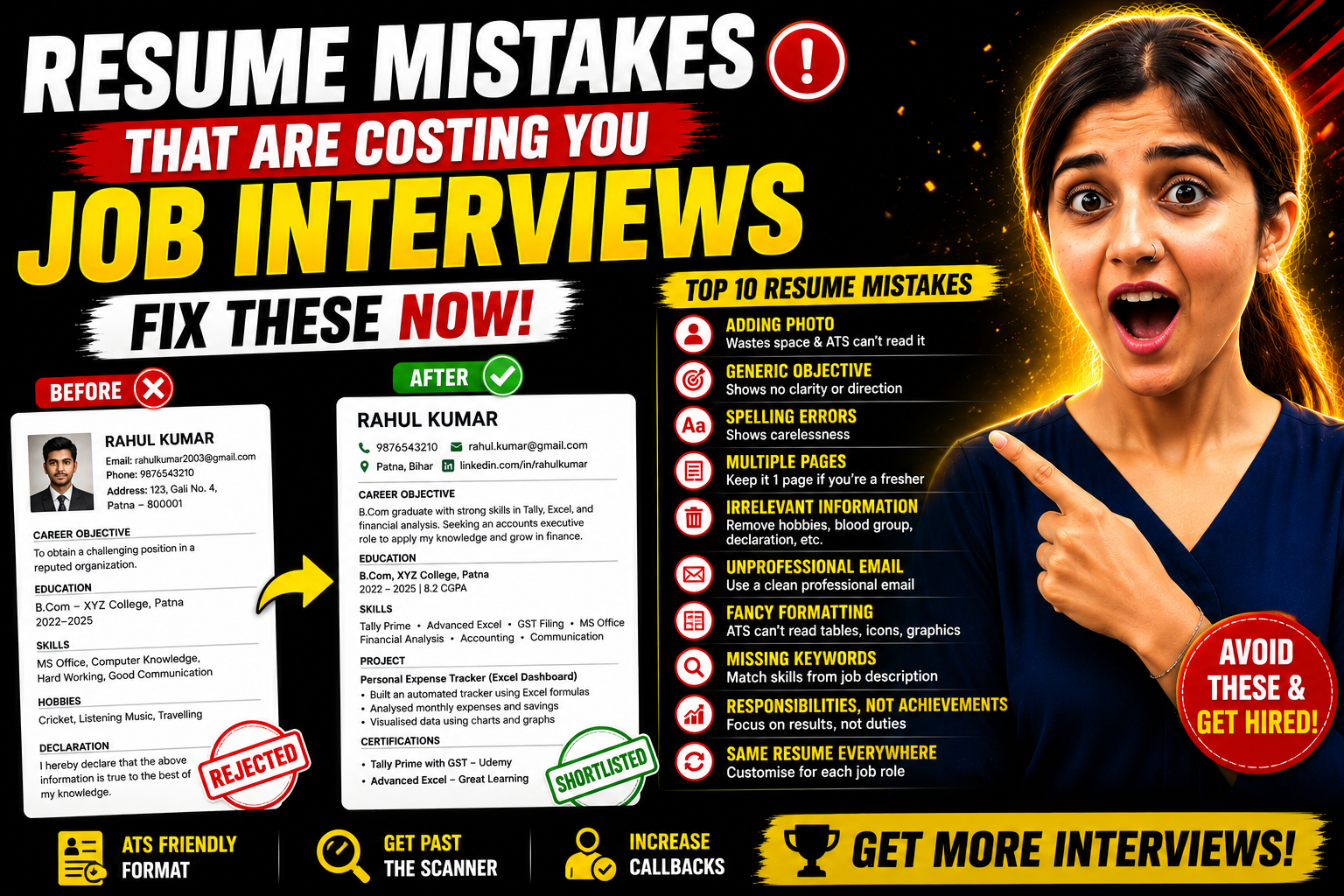
Before: Resume with passport photo in top-right corner, pushing the header and objective section down.
After: Photo removed. That space now holds 2 extra certifications and a LinkedIn URL.
A recruiter at Deloitte Gurgaon told me — “When I receive a resume with a photo, I don’t look at the face. I look at the wasted space. That corner could have shown me a Google certification or a project link.”
Mistake 2: Using a Generic Career Objective
❌ Before: “To obtain a challenging position in a reputed organization where I can utilize my skills and contribute to the growth of the company.”
Every recruiter in India has read this exact sentence 50,000 times. It says nothing about you, your skills, or the role you want.
✅ After: “BCA graduate with hands-on skills in Python, SQL, and data visualization. Completed Google Data Analytics certification. Seeking a data analyst role where I can apply my analytical skills to solve business problems.”
The second version has your degree, specific skills, a certification, and a clear target role. It takes 30 seconds to rewrite. But the difference in recruiter response is massive.
Mistake 3: Spelling and Grammar Errors
A single spelling mistake tells the recruiter — “This person doesn’t pay attention to detail.”
Real mistakes I’ve seen on Indian resumes:
- “Comunication skills” instead of Communication
- “Reponsiblities” instead of Responsibilities
- “Batchlor of Commerce” instead of Bachelor of Commerce
- “Devoloper” instead of Developer
According to a 2024 CareerBuilder survey, 58% of recruiters immediately reject resumes with typos. One word. Entire application gone.
Fix: After writing your resume, paste the entire text into Grammarly (free version). Read it aloud once — your ears catch what your eyes miss. Ask a friend to proofread. Never submit without at least two checks.
Mistake 4: Making the Resume 2-3 Pages as a Fresher
If you’re a fresher or have less than 3 years of experience — your resume must be one page. No exceptions.
A fresher in Lucknow sent me a 3-page resume. Page 1 had his photo, name, and a long career objective. Page 2 had education and a project. Page 3 had hobbies, declaration, and his father’s name. The useful content could fit in half a page. The recruiter has to dig through 3 pages to find it.
Rule:
- 0-5 years experience → 1 page
- 5-15 years experience → 2 pages maximum
- 15+ years → 2-3 pages (only for senior/executive roles)
Mistake 5: Including Irrelevant Information
Things that do NOT belong on a modern resume:
| Remove This | Why |
|---|---|
| Father’s/Mother’s name | Not relevant to job |
| Date of birth | Not required (age bias risk) |
| Marital status | Irrelevant to qualifications |
| Blood group | Not a job application — it’s not a hospital form |
| Full home address with PIN code | City and state is enough |
| “Declaration: I hereby declare…” | Outdated practice from the 1990s |
| Hobbies: Cricket, music, travelling | Adds zero professional value |
| References: Available upon request | Assumed — don’t waste the line |
A fresher in Patna had 6 lines of irrelevant personal details — including his passport number and languages known (Hindi, English — which is assumed for any graduate). Those 6 lines could have held 2 project descriptions or 3 certifications. Space on a one-page resume is precious. Every line must earn its place.
More Mistakes That Silently Kill Your Resume
Mistake 6: Using an Unprofessional Email Address
❌ coolguy.rahul2002@gmail.com
❌ sweetprincess.priya@yahoo.com
❌ rockstar_arjun@rediffmail.com
✅ rahul.sharma@gmail.com
✅ priya.verma.work@gmail.com
Takes 2 minutes to create a professional Gmail. Yet hundreds of Indian freshers apply with email addresses they made in class 8. A hiring manager in Bangalore said — “I received a resume from thunderbolt.destroyer@gmail.com. I couldn’t take it seriously, even though the skills were decent.”
Mistake 7: Using Fancy Templates With Tables and Graphics
Your Pinterest resume template with icons, coloured sidebars, skill progress bars, and two-column layouts looks beautiful — to humans. ATS reads it as scrambled garbage. 75% of Indian companies use ATS. If your resume can’t pass the software, no human ever sees your beautiful design.
Before: Two-column Canva template with icons, coloured headers, and skill percentage bars.
After: Single-column Google Docs template with standard headings, plain text, and simple bullet points. Same content. ATS reads 98% of it.
Mistake 8: Not Matching Keywords to the Job Description
The job description says “Power BI, SQL, Python, data storytelling.” Your resume says “data analysis, visualization, programming.” Same skills — different words. ATS doesn’t match them. Rejection.
Fix: Read every job description before applying. Copy the exact skill names they use. Add them to your resume’s skills section. This takes 5 minutes per application and doubles your callback rate.
Mistake 9: Listing Responsibilities Instead of Achievements
❌ Before: “Responsible for managing social media handles.”
✅ After: “Managed Instagram and LinkedIn for 3 clients, increasing follower engagement by 45% in 4 months.”
Responsibilities describe what you were supposed to do. Achievements describe what you actually delivered. Recruiters hire for results — not duties.
Mistake 10: Submitting the Same Resume Everywhere
One resume for developer roles, analyst roles, marketing roles, and support roles. This is the most common habit — and the most damaging. Each role needs different keywords highlighted, different skills prioritized, and a different career objective. A fresher in Chennai maintained 3 resume versions — one for developer roles, one for testing roles, one for analyst roles. Her callback rate was 3x higher than classmates using a single generic resume.
Frequently Asked Questions
Q1: Why is my resume not getting shortlisted?
Most likely — missing keywords (ATS filters you out), poor formatting (ATS can’t parse your resume), or generic content (recruiter sees nothing specific). Fix these three issues and your callback rate will improve noticeably. Test your resume on Jobscan.co to check ATS compatibility and keyword match percentage.
Q2: Should I put a photo in my resume in India?
No — unless the job specifically asks for one. Photos waste valuable resume space, can’t be read by ATS, and may introduce bias. MNCs actively discourage photos on resumes. Use that space for skills, certifications, or project descriptions instead. Your LinkedIn profile already has your photo — that’s enough.
Q3: How long should a fresher’s resume be?
Strictly one page. You don’t have enough relevant content for two pages. A focused one-page resume with strong skills, projects, and certifications makes a much better impression than a stretched two-page resume filled with hobbies, declarations, and personal details.
Q4: What are the most common resume mistakes freshers make?
Top five — generic career objective copied from Google, adding a photo, including irrelevant details (father’s name, blood group, declaration), using fancy templates ATS can’t read, and not customizing the resume for each job application. All of these are fixable in under 30 minutes.
Q5: Can spelling mistakes in a resume cost me a job?
Yes. 58% of recruiters reject resumes with typos, according to CareerBuilder. A single spelling error signals carelessness. Always proofread using Grammarly (free), read your resume aloud, and have a friend review it before submitting. One typo can undo an otherwise strong resume.
Your Resume Has 6 Seconds to Impress — Don’t Waste Them on Mistakes
Here’s the simple math. A recruiter looks at your resume for 6 seconds. If those 6 seconds show a photo, a generic objective, “Hobbies: cricket,” and a declaration — you’re done. If they show specific skills, a real achievement, and a clean layout — you get the call.
Open your resume right now. Check it against every mistake in this article. Fix what needs fixing. Remove what doesn’t belong. Add what’s missing.
Lakhs of candidates across Delhi, Mumbai, Bangalore, and Pune are losing interviews over mistakes that take 20 minutes to fix. Don’t be one of them.
Your skills deserve to be seen. Fix the resume that’s hiding them. 💪