
Your phone rings. “Hi, can you come for an interview tomorrow at 11 AM?” You say yes. You hang up. Then panic hits — you have exactly one day to prepare. No week. No weekend. One day.
Most candidates in this situation do one of two things — stay up all night googling random questions, or give up and “wing it.” Both approaches fail.
Here’s the good news — one day is enough. If you use those hours strategically, you can walk in more prepared than candidates who had a week but wasted it scrolling Instagram.
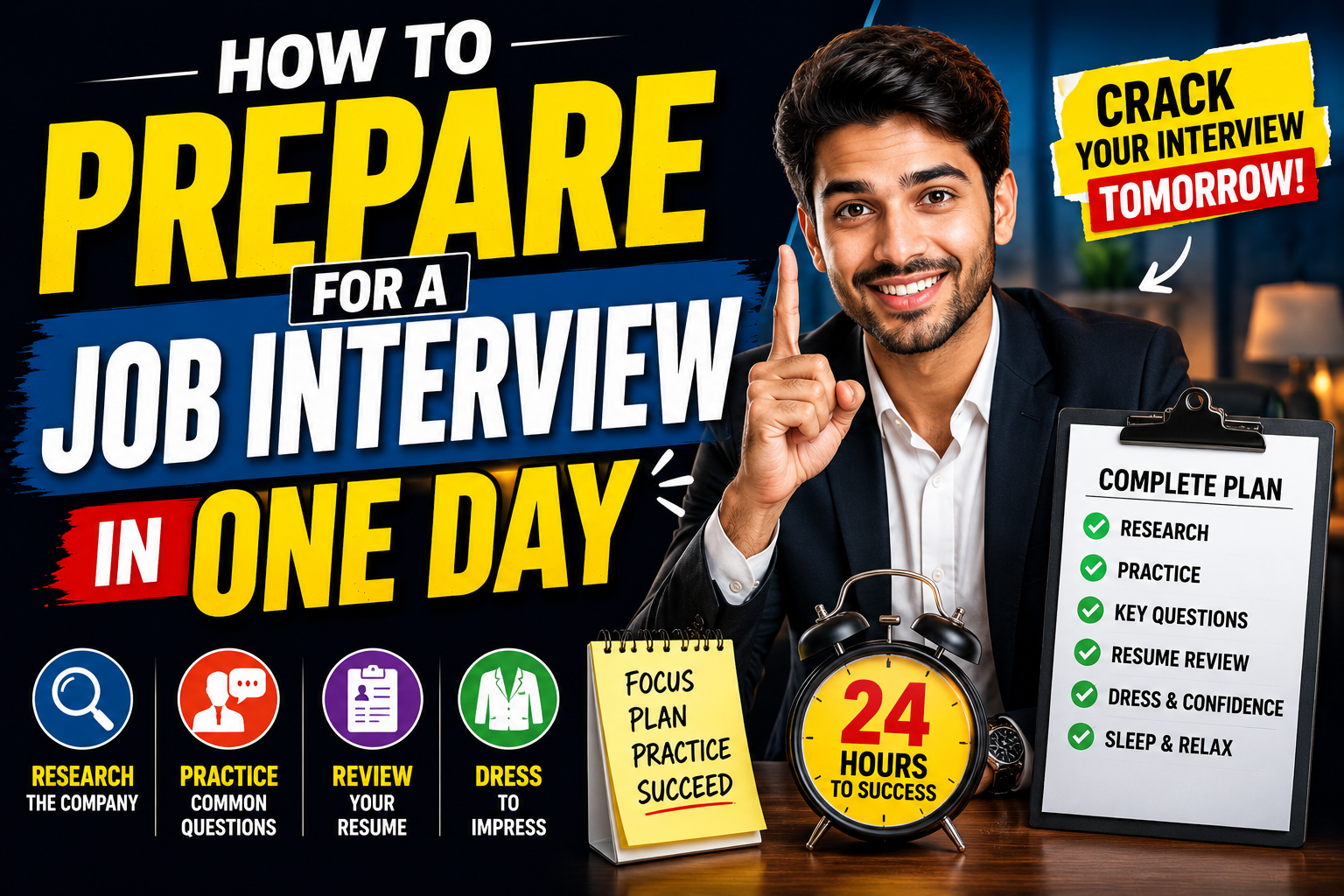
In this article, I’ll give you an exact hour-by-hour preparation plan — from company research to outfit to sleep — so you’re fully ready in 8 focused hours.
The 8-Hour Interview Preparation Plan — Hour by Hour
You have one day. Here’s exactly how to spend it.
| Time Block | Activity | Duration |
|---|---|---|
| Hour 1-2 | Company and job research | 2 hours |
| Hour 3-4 | Prepare answers to top 10 questions | 2 hours |
| Hour 5 | Mock interview practice (aloud) | 1 hour |
| Hour 6 | Outfit, documents, route preparation | 1 hour |
| Hour 7 | Relax, light meal, mental preparation | 1 hour |
| Hour 8 | Early sleep — minimum 7 hours before waking | 1 hour wind-down |
This isn’t theory. A fresher in Pune got an interview call at 4 PM for the next morning at 10 AM. She followed a structured 6-hour plan that evening — researched the company, practised 8 questions aloud, ironed her outfit, packed documents, and slept by 11 PM. She got the offer. Her preparation wasn’t longer than others — it was more focused.
Let me break down each block in detail.
Hour 1-2: How to Research the Company Before Interview
This is the most skipped step — and the most impactful. When the interviewer asks “What do you know about our company?” and you say “Umm… you guys do IT stuff, right?” — the interview is practically over.
What to research and where to find it:
| What to Find | Where to Look | Time |
|---|---|---|
| Company’s products/services | Company website → About Us, Products page | 15 min |
| Recent news or achievements | Google “[Company name] news 2026” | 10 min |
| Company size and locations | LinkedIn company page | 5 min |
| Founders and leadership | Company website → Team page, LinkedIn | 10 min |
| Company culture and reviews | Glassdoor, AmbitionBox | 10 min |
| Your interviewer’s background | LinkedIn (search their name) | 10 min |
| Job description keywords | Re-read the job posting carefully | 15 min |
How to use this research in the interview:
When asked “Why do you want to work here?” — don’t say “Because it’s a good company.” Say — “I read that your company recently expanded into AI-powered logistics solutions. That aligns with my interest in data-driven systems. I also noticed your Glassdoor reviews highlight strong mentorship culture — which is exactly what I’m looking for early in my career.”
A fresher in Bangalore researched her interviewer on LinkedIn and discovered he had published a post about Python automation the previous week. During the interview, she naturally mentioned — “I noticed your LinkedIn post about automating reports with Python. I actually did something similar in my final year project.” The interviewer was visibly impressed. She got the offer. 10 minutes of LinkedIn research created a genuine connection.
Job description analysis — the most important 15 minutes:
Print or screenshot the job description. Highlight every skill, tool, and qualification mentioned. These are the keywords the interviewer will ask about. If the JD says “React.js, REST APIs, team collaboration” — prepare to discuss each one specifically. Match 3-4 of your skills directly to their requirements before the interview.
Hour 3-4: Prepare Answers to the Top 10 Questions
You can’t predict every question. But you can prepare for the 10 that appear in 90% of Indian interviews.
The must-prepare list:
| Question | Preparation Approach |
|---|---|
| Tell me about yourself | Present-Past-Future formula, 60-90 seconds |
| Why should we hire you | Match your skills to job description |
| What are your strengths | One strength + one specific example |
| What are your weaknesses | One real weakness + improvement story |
| Why do you want this job | Reference company research + career goals |
| Where do you see yourself in 5 years | Growth in this field/role, not job title obsession |
| Tell me about a challenge you faced | STAR method — Situation, Task, Action, Result |
| What are your salary expectations | Research market range on Glassdoor/AmbitionBox first |
| Why are you leaving current job | Focus on growth opportunity, never badmouth employer |
| Do you have any questions for us | Prepare 2-3 thoughtful questions |
Write your answers in bullet points — not full scripts. Full scripts sound robotic when delivered. Bullet points give you structure but allow natural delivery.
Two questions to always prepare for “Do you have questions for us?”
- “What does a typical day look like in this role?” — shows genuine interest
- “What are the key expectations for this role in the first 3 months?” — shows you’re already thinking about delivering results
According to a 2025 Naukri hiring survey, 88% of interviewers said they negatively judge candidates who say “No, I don’t have any questions.” Always ask at least 2 questions. It signals curiosity and preparation.
Hour 5: Mock Interview Practice — Say It Aloud
Reading your answers in your head is not practice. Saying them aloud is practice. There’s a massive difference.
How to practise in one hour:
First 20 minutes: Stand in front of a mirror. Answer each of the 10 questions aloud. Time yourself — each answer should be 60-90 seconds. If it runs over 2 minutes, cut it down.
Next 20 minutes: Record yourself on your phone answering 3-4 key questions. Play it back. Listen for filler words — “umm,” “like,” “basically,” “you know.” Notice your pace — are you speaking too fast? Too slow? Adjust.
Last 20 minutes: Call a friend or family member. Ask them to randomly ask you 5 questions from the list. Answer without looking at your notes. This simulates real interview pressure.
A fresher in Chennai practised with her roommate for 40 minutes the night before her TCS interview. Her roommate asked unexpected follow-up questions — “Why Python and not Java?” — that forced her to think on her feet. In the actual interview, a similar follow-up came. She handled it smoothly because she’d already faced it during practice.
Hour 6: Outfit, Documents, and Route — The Logistics Checklist
What to wear for an interview in India:
| Setting | Men | Women |
|---|---|---|
| Corporate / MNC | Formal shirt, trousers, leather shoes | Formal kurta/top, trousers/skirt, closed shoes |
| Startup | Smart casual — collared shirt, clean jeans/chinos | Smart casual — neat top, trousers, clean footwear |
| Bank / Government | Strict formal — light shirt, dark trousers, tie optional | Strict formal — saree, salwar suit, or formal western |
Rules that apply everywhere: Clean, ironed clothes. No wrinkles. Neutral colours — white, light blue, grey, beige, navy. No flashy prints. Clean shoes. Minimal accessories. Light perfume or deodorant — never heavy fragrance.
Iron your outfit tonight. Don’t leave it for morning.
Documents to carry — the checklist:
- 3-4 printed copies of your resume
- Original and photocopy of all degree certificates
- ID proof (Aadhaar, PAN, or passport)
- Passport-size photos (4 copies)
- Previous company experience letters (if applicable)
- Offer letter / relieving letter from last company (if applicable)
- A pen and small notebook
Put everything in a clean folder or file tonight. A fresher in Delhi arrived at her interview and realized she’d forgotten her resume printouts. She had to ask the receptionist to print one. It started the interview on an awkward, unprepared note. Pack everything the night before.
Route preparation:
- Google Maps the location tonight. Check the travel time.
- Add 30 minutes buffer for traffic and finding the building.
- If the interview is at 11 AM and travel takes 45 minutes — leave by 9:45 AM.
- Reach 15-20 minutes early. Not 5 minutes. Not 45 minutes.
Hour 7-8: Relax, Eat, and Sleep — Mental Preparation
Hour 7 — Wind down.
Eat a light, comfortable meal — dal-rice, roti-sabzi, something familiar. Avoid heavy or spicy food that might cause discomfort the next morning. No caffeine after 6 PM — it disrupts sleep. Put your phone away. Stop googling more interview tips. You’ve prepared enough.
Calming interview nerves — quick techniques:
- Box breathing: Breathe in 4 seconds, hold 4 seconds, breathe out 4 seconds, hold 4 seconds. Repeat 5 times. This reduces heart rate and anxiety within 2 minutes.
- Power posing: Stand with feet apart, hands on hips, chest open for 2 minutes. A 2024 study in the Journal of Applied Psychology found this posture reduces cortisol (stress hormone) and increases confidence before high-pressure situations.
- Positive visualization: Close your eyes. Imagine walking into the interview room. The interviewer smiles. You sit confidently. You answer clearly. You walk out feeling good. This mental rehearsal prepares your brain for the real event.
Hour 8 — Sleep.
Set your alarm. Keep clothes and documents ready. Sleep at least 7 hours. A Harvard Business Review study found that candidates who slept 7+ hours performed significantly better in interviews than those who stayed up late cramming. Your brain consolidates memories and reduces anxiety during sleep. Staying up until 3 AM practising questions is worse than sleeping at 11 PM and letting your brain process what you’ve already learned.
Frequently Asked Questions
Q1: How to prepare for an interview in just one day?
Follow the 8-hour plan — 2 hours company research, 2 hours answer preparation, 1 hour mock practice, 1 hour logistics (outfit, documents, route), 1 hour relaxation, and early sleep. Focus on the top 10 most common questions and match your skills to the job description. One focused day beats one unfocused week.
Q2: What should I study the night before an interview?
Research the company — products, recent news, culture. Re-read the job description and match your skills to their requirements. Prepare answers for “tell me about yourself,” “why should we hire you,” and “strengths and weaknesses.” Practise aloud, not just in your head. Then stop studying and sleep by 11 PM.
Q3: How to reduce interview anxiety quickly?
Box breathing (4-4-4-4 pattern) works within 2 minutes. Power posing for 2 minutes reduces stress hormones. Remind yourself — the interviewer wants you to succeed. They’re not trying to trap you. Arriving 15-20 minutes early also reduces anxiety because you’re not rushing. Preparation is the best anxiety killer.
Q4: What documents should I carry to an interview?
3-4 resume printouts, original degree certificates with photocopies, ID proof (Aadhaar/PAN), passport photos, experience and relieving letters from previous employers, and a pen with notebook. Pack everything in a clean folder the night before. Don’t leave anything for the morning.
Q5: How early should I reach for an interview?
15-20 minutes before the scheduled time. This gives you time to find the location, use the washroom, compose yourself, and review your notes briefly. Arriving 5 minutes late creates a terrible first impression. Arriving 45 minutes early makes you look anxious. 15-20 minutes is the perfect window.
One Day Is All You Need — If You Use It Right
Here’s the truth — most candidates who get a week to prepare waste 6 days and cram on the last night. You have one day. Use it fully and you’ll be better prepared than half the candidates who had more time.
Research the company for 2 hours. Prepare your top 10 answers. Practise aloud. Pack your outfit and documents. Eat a light meal. Sleep 7 hours. Wake up calm.
The interview isn’t testing how many days you prepared. It’s testing whether you show up informed, confident, and ready to answer clearly.
8 hours of focused preparation. That’s your edge. Start now. 💪