
You completed 8 online courses. You have certificates from Coursera, Udemy, Google, HubSpot, and LinkedIn Learning. You want to add them all to your resume. But where? In what format? Do they all carry the same value? Will employers even care?
Most Indian job seekers dump all their certificates into one messy list at the bottom of their resume. No order. No context. No indication of which ones actually matter. The recruiter glances at it, sees 8 random course names, and moves on.
Certifications can genuinely set your resume apart — but only if you list them correctly. In this article, I’ll show you exactly where to place certifications, which ones carry real value, and how to format them so recruiters actually notice.
Are All Online Certifications Equal — Platform-Wise Value Comparison
Let’s be honest. A Google Professional Certificate and a ₹399 Udemy course don’t carry the same weight. Recruiters know the difference. You should too.
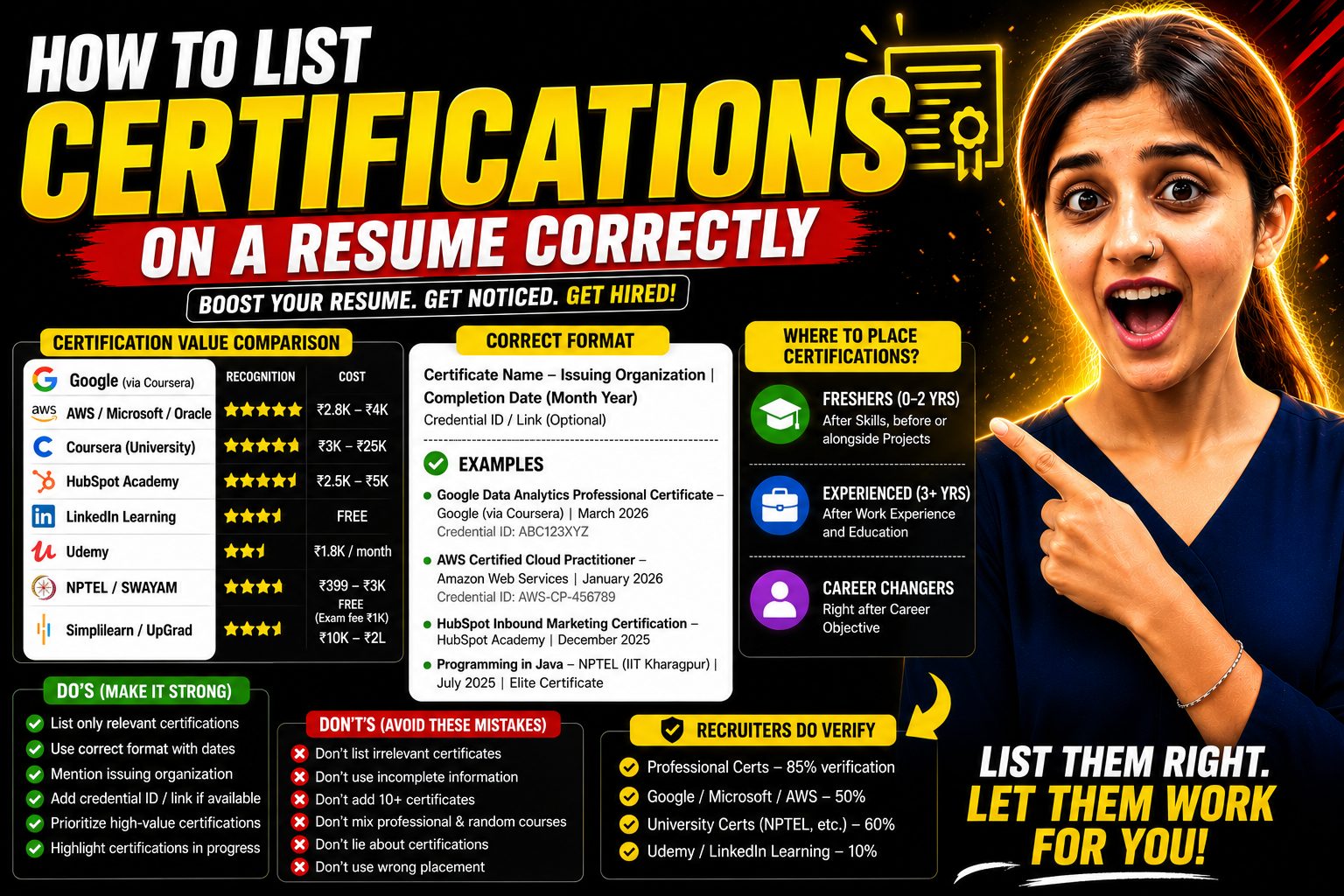
| Platform | Employer Recognition | Cost | Best For |
|---|---|---|---|
| Google Certificates (via Coursera) | Very High — Google’s brand + industry projects | ₹2,800-₹4,000 | Data Analytics, Digital Marketing, IT Support, Project Management |
| AWS / Microsoft / Oracle | Very High — industry-standard vendor certs | ₹3,000-₹25,000 | Cloud, DevOps, Database, Enterprise IT |
| Coursera (University courses) | High — partnered with IITs, Stanford, IBM | ₹2,500-₹5,000 | Technical and business skills |
| HubSpot Academy | High — recognized in marketing/sales | Free | Inbound Marketing, Content, Email Marketing |
| LinkedIn Learning | Medium — shows initiative, not deep expertise | ₹1,800/month | Soft skills, business tools, basics |
| Udemy | Low-Medium — depends on the specific course | ₹399-₹3,000 | Quick skill-building, not strong as resume credential |
| NPTEL / SWAYAM | High in India — IIT/IISc professors, government backed | Free (exam fee ₹1,000) | Engineering, science, technical subjects |
| Simplilearn / UpGrad / Great Learning | Medium-High — depends on the program | ₹10,000-₹2,00,000 | Career-track certifications |
A fresher in Bangalore listed 6 Udemy certificates on his resume. The interviewer didn’t ask about any of them. His friend listed 2 certificates — Google Data Analytics and AWS Cloud Practitioner. The interviewer spent 5 minutes discussing those two. Platform credibility matters.
Key insight: A 2025 LinkedIn India hiring survey found that 72% of recruiters recognize Google, AWS, and Microsoft certifications as strong resume additions. Only 28% said the same about Udemy. This doesn’t mean Udemy is useless — it means you should learn on Udemy but certify through recognized platforms.
Where to Put Certifications in Resume — Placement and Format
Placement depends on your experience level and how relevant the certification is.
For freshers (0-2 years): Place certifications immediately after Skills — before or after Projects. Your certifications compensate for lack of work experience. They need high visibility.
For experienced professionals (3+ years): Place certifications after Work Experience and Education. Your work history speaks louder — certifications support it.
For career changers: Place certifications right after the Career Objective. They prove you’ve prepared for the new field.
Correct Format for Listing Certifications
Format:
Certificate Name — Issuing Organization | Completion Date
Examples:
✅ Google Data Analytics Professional Certificate — Google (via Coursera) | March 2026
✅ AWS Certified Cloud Practitioner — Amazon Web Services | January 2026
✅ HubSpot Inbound Marketing Certification — HubSpot Academy | December 2025
✅ Programming in Java — NPTEL (IIT Kharagpur) | July 2025 | Elite Certificate
What to include for each certification:
- Full certificate name (exactly as printed)
- Issuing organization
- Completion date (month and year)
- Certificate ID or credential link (optional — if the platform provides one)
- Special achievement (if applicable — “Elite” for NPTEL, “with Distinction” for Coursera)
What NOT to do:
❌ “Completed various online courses from Coursera and Udemy” — this tells the recruiter nothing specific.
❌ “Certificate 1, Certificate 2, Certificate 3” — no issuing body, no dates, no context.
A BCom graduate in Jaipur listed her certifications like this: “Tally, GST, Excel, Accounting.” No platform names. No dates. The recruiter couldn’t tell if these were formal certifications or YouTube videos she watched. She reformatted — “Tally Prime Certification — Tally Education | Feb 2026” — and got compliments in her next interview for a well-organized resume.
How to Handle Special Certification Situations — Step by Step
Step 1: Certification in progress — mention it clearly.
If you’re currently pursuing a certification, still add it. Use this format:
“AWS Solutions Architect Associate — Amazon Web Services | Expected August 2026”
Or: “Google UX Design Certificate — Coursera | In Progress (4 of 7 courses completed)”
This shows initiative. A hiring manager in Hyderabad told me — “I’d rather see a candidate pursuing AWS certification than one who hasn’t started anything. It tells me they’re invested in growth.”
Step 2: Expired certification — decide if it’s still relevant.
Some certifications expire — AWS, Google Ads, PMP. If expired within the last 12 months, list it with the note “(Renewal in progress).” If expired 2+ years ago, remove it or list it under “Previous Certifications” — only if the underlying skill is still relevant to the role.
Step 3: Too many certifications — prioritize ruthlessly.
If you have 10+ certificates, don’t list all of them. Pick the 4-5 most relevant to the job you’re applying for. A data analyst applying for an analytics role should show Google Data Analytics, SQL certification, and Power BI — not their HubSpot Marketing and graphic design certificates.
Rule: If the certification isn’t relevant to the job description, leave it off this application. You can always include it for a different role.
Step 4: Government or statutory certifications — highlight them.
ICAI (CA), ICSI (CS), ICMAI (CMA), IRDA, NISM — these carry legal and professional weight. Place them in a separate “Professional Certifications” section above online courses. A CA Inter candidate listing ICAI certification alongside a random Udemy course is diluting a serious credential.
Do Employers Verify Certifications on Resumes — The Truth
Yes — but selectively.
A 2025 HireRight India background check report found:
| Certification Type | Verification Rate |
|---|---|
| Professional (CA, PMP, AWS, CISSP) | 85% — almost always verified |
| University-issued (NPTEL, IIT courses) | 60% — often verified |
| Google / Microsoft / IBM certificates | 50% — verified if relevant to role |
| Coursera / edX course certificates | 30% — occasionally checked |
| Udemy / LinkedIn Learning | 10% — rarely verified |
How do companies verify?
- Credential ID check on the issuing platform’s website
- Asking candidates to show the certificate or digital badge during interview
- Background verification agencies (like HireRight, AuthBridge) checking certificate databases
- Some companies ask for login access to your Coursera/Google profile
What happens if you lie?
A developer in Chennai listed “AWS Solutions Architect” on his resume. He had only watched a YouTube course on AWS — never took the exam. During the interview, the technical panel asked for his certification ID. He couldn’t provide one. The offer was revoked. His name was flagged in the company’s internal database.
Lying about certifications is risky — and unnecessary. If you’ve done the learning but not the exam, write it honestly: “AWS Cloud — Self-studied (Certification planned Q3 2026).” Honesty builds trust. Fake credentials destroy careers.
A fresher in Mumbai listed a Google certification she never completed. The recruiter checked the credential link — it was invalid. Not only did she lose that opportunity, the recruiter shared the incident internally. One lie closed multiple doors.
Common Certification Listing Mistakes
Mistake 1: Listing every certificate you’ve ever earned.
10 certificates on a resume looks like certificate hoarding — not genuine learning. An HR manager in Delhi said — “When I see 12 certifications and zero projects, I think this person just collects certificates without applying anything.” Pick the 4-5 most relevant. Quality over quantity.
Mistake 2: Not including the issuing organization.
“Digital Marketing Certificate” — from where? Google? A random ₹200 website? Without the issuing body, the certification has no credibility. Always include the platform or organization name.
Mistake 3: Mixing professional certifications with online courses.
A CA certification and a Udemy “Introduction to Excel” course have vastly different credibility. Don’t list them together. Create separate sub-sections if needed — “Professional Certifications” and “Online Courses & Training.”
Mistake 4: Adding certifications that contradict your experience level.
A fresher listing “Advanced Machine Learning Specialization” who can’t explain a basic algorithm in the interview damages credibility. Only list certifications you can confidently discuss. If you completed it but didn’t understand it deeply — leave it off until you can defend it.
Frequently Asked Questions
Q1: Should I add online certifications to my resume?
Yes — if they’re from recognized platforms and relevant to the job. Google, AWS, Microsoft, HubSpot, and NPTEL certifications carry real weight. Even Coursera university courses add value. But only list certifications relevant to the specific role you’re applying for. Irrelevant certificates clutter your resume without adding value.
Q2: Are Udemy certificates valid for jobs in India?
Udemy is great for learning — but its certificates carry limited weight with recruiters. Only 28% of hiring managers consider Udemy certificates as strong resume additions. If you learn a skill on Udemy, consider getting certified through a recognized platform like Google, AWS, or NPTEL to strengthen your resume credibility.
Q3: Where exactly should I put certifications on my resume?
Freshers — after Skills, before or alongside Projects. Experienced professionals — after Work Experience and Education. Career changers — right after the Career Objective. The more relevant the certification to your job application, the higher it should appear on your resume.
Q4: How to mention a certification that’s in progress?
Use this format: “Certificate Name — Issuing Organization | In Progress (Expected [Month Year]).” Example: “AWS Cloud Practitioner — Amazon Web Services | Expected September 2026.” This shows initiative and commitment. Recruiters value candidates who are actively upskilling.
Q5: Do employers actually verify certifications on resumes?
Professional certifications (CA, AWS, PMP) are verified 85% of the time. Google and Microsoft certificates are checked about 50% of the time. Udemy and LinkedIn Learning certificates are rarely verified — around 10%. However, interviewers may ask you to explain what you learned. If you can’t, the certification backfires. Never list what you can’t defend.
The Right Certifications Listed the Right Way — That’s the Formula
Here’s the bottom line — certifications add real value to your resume. But only if they’re relevant, credible, and properly formatted. Four well-chosen certifications from recognized platforms beat ten random ones from anywhere.
Check your resume tonight. Remove certificates that aren’t relevant to your target role. Format the remaining ones properly — full name, issuing body, completion date. Place them where recruiters will actually see them.
Your certifications prove you’re a learner. Your formatting proves you’re professional. Show both.
List them right. Let them work for you. 💪