
“Tell me about a time you handled a difficult situation.” You hear this question. Your brain scrambles through memories. You start talking — jumping between 3 different stories, forgetting details, losing the point. Two minutes later, the interviewer is confused and you’re frustrated.
Behavioral questions are the fastest-growing category in Indian interviews. TCS, Infosys, Amazon, HDFC, Deloitte — all major recruiters now ask them. And most candidates fail because they ramble instead of telling a clear story.
The STAR method fixes this. It’s a simple 4-part structure that turns any experience into a focused, impressive answer. In this article, I’ll explain exactly how to use it — with 5 complete examples you can adapt, including answers for freshers with no work experience.
What Is the STAR Method — Explained Simply
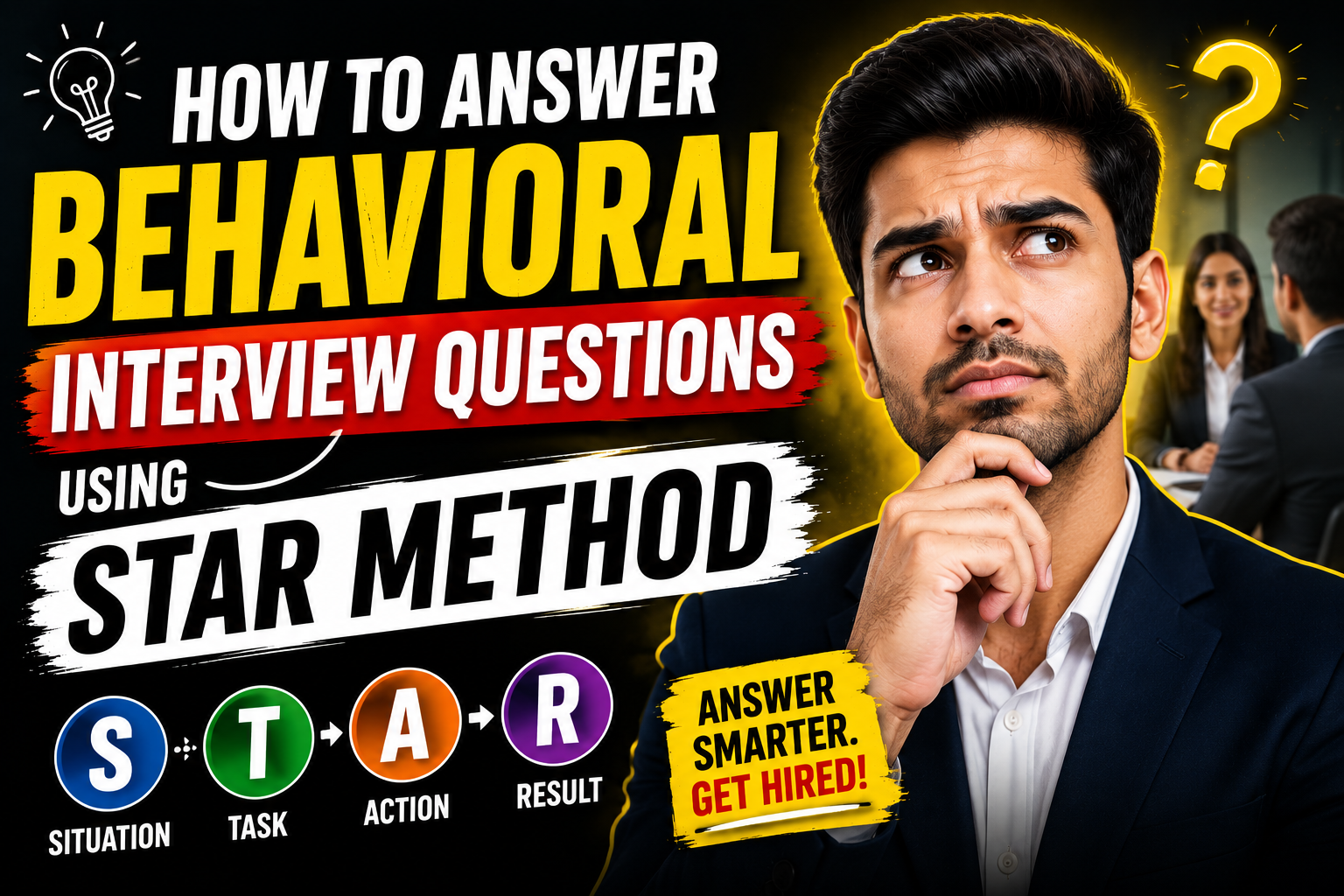
STAR stands for Situation, Task, Action, Result. It’s a framework for answering any “Tell me about a time when…” question in under 90 seconds.
| Step | What to Say | Time |
|---|---|---|
| S — Situation | Set the scene. Where were you? What was happening? | 15-20 seconds |
| T — Task | What was your specific responsibility? | 10-15 seconds |
| A — Action | What did YOU do? (Not the team — you) | 20-25 seconds |
| R — Result | What happened? Use numbers if possible | 15-20 seconds |
Total: 60-90 seconds. That’s the perfect length for a behavioral answer.
Why do interviewers ask behavioral questions?
Because past behavior predicts future behavior. If you’ve handled pressure well once, you’ll likely handle it again. If you’ve resolved a conflict before, you can probably do it at their company too.
According to a 2025 LinkedIn India Hiring Report, 72% of Indian companies now include at least 2-3 behavioral questions in every interview round. Amazon asks almost entirely behavioral questions — their entire interview process is built around the STAR method. Even traditional Indian companies like TCS and HDFC have shifted toward behavioral interviewing.
A recruiter at Amazon Bangalore told me — “We don’t care about hypothetical answers. ‘I would handle it by…’ means nothing. We want ‘I handled it by…’ Every answer must be a real experience with a real result.”
Can Freshers Use the STAR Method With No Work Experience — Yes, Here’s How
This is the biggest concern freshers have. “I don’t have work experience. What situations do I even talk about?”
You have more experiences than you realize. Your STAR stories can come from:
| Source | Example Situations |
|---|---|
| College projects | Missed deadlines, technical challenges, team disagreements |
| Internships | Client interactions, task management, learning new tools |
| College events | Organizing fests, managing budgets, leading teams |
| Sports / Competitions | Handling pressure, teamwork, bouncing back from losses |
| Part-time work | Customer handling, multitasking, solving problems |
| Personal projects | Self-learning, building something from scratch |
A BCA fresher in Lucknow had zero work experience. But she had organized her college’s tech fest, led a 10-person team, and managed a ₹50,000 budget. She used these experiences for every behavioral question — teamwork, leadership, problem-solving, handling pressure. She got hired at a Bangalore IT company. Her stories were from college — but they proved professional qualities.
The rule: The interviewer doesn’t care where the story comes from. They care that it’s real, structured, and shows the quality they’re testing for.
5 Complete STAR Method Examples — Ready to Adapt
Example 1: “Tell me about a time you failed”
Situation: “During my final semester project at college, our team of 4 was building a student attendance app using Java and MySQL.”
Task: “I was responsible for the backend API — connecting the database to the frontend.”
Action: “I underestimated the complexity and didn’t ask for help. I tried to build everything myself and skipped testing until the last week. When we finally tested, the database connection kept crashing under multiple user loads.”
Result: “We presented a partially working prototype instead of the full product. We scored 7 out of 10 instead of the 9 we were targeting. I learned two things — break large tasks into daily milestones and test throughout, not just at the end. In my next project, I set daily check-ins and finished 4 days ahead of schedule with zero bugs.”
Why it works: Admits a real failure honestly. Shows specific learning. Proves the lesson was applied in the next project. Interviewers love the “what I learned” ending.
Example 2: “Tell me about a time you worked in a team”
Situation: “During my internship at a digital agency in Pune, I was assigned to a 5-member team handling social media for a D2C skincare brand.”
Task: “I was responsible for creating Instagram content calendars. But the designer and I kept disagreeing on visual style — she wanted minimalist designs, I wanted bold colours matching the brand guidelines.”
Action: “Instead of escalating to our manager, I set up a 30-minute call with the designer. I showed her the brand guideline document and we compared both approaches. We agreed to test both styles for one week — 3 posts in each style — and let engagement data decide.”
Result: “The bold-colour posts got 40% more engagement. The designer agreed to follow the brand style. Our working relationship improved after that — we started reviewing each other’s work before submitting. The client praised the content quality that month.”
Example 3: “Tell me about a time you handled pressure”
Situation: “During college placements, I had 3 interviews scheduled in the same week — TCS on Tuesday, Infosys on Thursday, and a startup on Friday.”
Task: “Each company had different focus areas — TCS wanted coding, Infosys wanted aptitude and HR, and the startup wanted a project presentation. I had to prepare for all three with different strategies.”
Action: “I created a 5-day preparation plan. Monday — coding practice for TCS. Wednesday — aptitude mock tests and HR questions for Infosys. Thursday evening — polished my project presentation for the startup. I practised each day’s questions aloud for 1 hour before sleeping.”
Result: “I cleared TCS and the startup interview. I reached the final round at Infosys but didn’t convert. Still, preparing systematically under time pressure taught me that structured planning beats panicked cramming. I accepted the startup offer at ₹5.2 LPA.”
Example 4: “Tell me about a leadership experience”
Situation: “In my third year of college, I was selected as the coordinator for our annual tech fest — TechSpark 2025.”
Task: “I had to manage a team of 12 volunteers, organize 8 events, handle sponsor outreach, and manage a budget of ₹75,000 — all while keeping up with classes.”
Action: “I divided the team into 3 sub-groups — events, logistics, and sponsorship. I assigned a lead for each group and held daily 15-minute standup meetings for the last 2 weeks. When our main sponsor pulled out 10 days before the event, I personally contacted 5 local businesses and secured ₹30,000 in emergency sponsorship within 4 days.”
Result: “TechSpark had 600+ attendees — the highest in our college’s history. We came in under budget by ₹8,000. The dean publicly acknowledged our team during the closing ceremony. I learned that delegation and daily check-ins keep large projects on track.”
Example 5: “Tell me about a time you solved a problem”
Situation: “During my 3-month internship at an accounting firm in Jaipur, I was assigned to help with GST return filing for 8 clients.”
Task: “One client’s sales data had a ₹2.3 lakh mismatch between their internal records and the GSTR-2A auto-populated data. My supervisor asked me to find and fix the discrepancy.”
Action: “I compared the client’s monthly sales register with GSTR-2A entries line by line for Q3. I discovered that 4 vendor invoices had been recorded under the wrong GSTIN — the vendor had multiple branches with different GSTINs and the client’s accountant had mixed them up. I created a reconciliation sheet mapping each vendor to their correct GSTIN.”
Result: “The mismatch was resolved within 2 days. My supervisor used my reconciliation template for 3 other clients with similar issues. The client avoided a potential GST notice and thanked our firm specifically. My supervisor gave me more complex assignments after that.”
How to Prepare Your Own STAR Stories — Step by Step
Step 1: List 8-10 experiences from the last 3 years.
College projects, internships, events, competitions, part-time work, volunteer activities, team assignments. Write one line about each. This is your raw material.
Step 2: Tag each experience with the quality it demonstrates.
Teamwork, leadership, problem-solving, handling failure, working under pressure, conflict resolution, initiative. Each experience can demonstrate multiple qualities. Tag them all.
Step 3: Pick 5-6 strongest stories.
Choose stories with clear actions and measurable results. A story without a result is incomplete. “We organized an event” is weak. “We organized an event with 600 attendees and ₹75,000 budget, finishing ₹8,000 under budget” is strong.
Step 4: Write each story in the STAR format.
Situation — 2 sentences. Task — 1-2 sentences. Action — 2-3 sentences focusing on what YOU did. Result — 1-2 sentences with numbers. Total — 8-10 sentences per story.
Step 5: Practise aloud — time each answer to 60-90 seconds.
Reading in your head is different from speaking aloud. Practise until each story flows naturally without reading notes. A marketing fresher in Mumbai practised 5 STAR stories over 2 evenings. In her interview, 3 of the 4 behavioral questions matched stories she had prepared. She got the offer.
Common STAR Method Mistakes
Mistake 1: Spending too long on Situation and Task.
The interviewer doesn’t need a 45-second backstory. Keep S and T to 25-30 seconds combined. The Action is where you shine — that’s what they want to hear most.
Mistake 2: Using “we” instead of “I.”
“We resolved the issue” doesn’t tell the interviewer what YOU did. Change “we” to “I” — “I analysed the data. I proposed the solution. I coordinated with the team.” Teams matter — but the interviewer is hiring you, not your team.
Mistake 3: Forgetting the Result.
A story without a result is like a movie without an ending. Always end with what happened — and add a number if possible. “Engagement increased by 40%.” “We finished under budget by ₹8,000.” “I was assigned more complex tasks after that.” Results prove impact.
Mistake 4: Making up a story.
Interviewers ask follow-up questions. “What exactly did you say to the designer?” “How did the client react?” Fake stories collapse under follow-ups. Use real experiences — even small ones. An honest college project story beats a fabricated corporate drama every time.
Frequently Asked Questions
Q1: What is the STAR method in interviews?
STAR stands for Situation, Task, Action, Result — a 4-part structure for answering behavioral questions like “Tell me about a time when…” It keeps your answer focused, organized, and under 90 seconds. Most recruiters at major Indian companies expect candidates to use this format or something similar.
Q2: How long should a STAR method answer be?
60-90 seconds. Situation and Task — 25-30 seconds combined. Action — 20-25 seconds. Result — 15-20 seconds. Anything over 2 minutes loses the interviewer’s attention. Practise with a timer to stay within range.
Q3: Can freshers use the STAR method with no work experience?
Absolutely. Use experiences from college projects, internships, event organizing, competitions, sports, volunteer work, or personal projects. The interviewer doesn’t care where the story is from. They care that it’s real, structured, and shows the quality they’re testing — teamwork, leadership, problem-solving, or resilience.
Q4: How many STAR examples should I prepare?
Prepare 5-6 stories covering teamwork, leadership, failure, pressure, problem-solving, and conflict resolution. Most interviews ask 2-4 behavioral questions. With 5-6 prepared stories, you’ll have a relevant answer for almost any question. Some stories can be reframed to answer multiple question types.
Q5: What if I can’t think of a STAR example during the interview?
Pause for 5 seconds — silence is better than rambling. Say “Let me think of the best example for this…” while your brain searches. If you truly can’t recall a work example, use a college or personal example. If nothing fits, honestly say — “I haven’t faced that exact situation, but here’s how I’d approach it…” and give a thoughtful hypothetical. Honesty beats a forced, unconvincing story.
Every Behavioral Question Has One Answer Format — Learn It Once
Here’s the truth — behavioral questions seem unpredictable, but the answer format is always the same. Situation. Task. Action. Result. Whether they ask about failure, teamwork, leadership, or pressure — the structure doesn’t change.
Prepare 5 real stories tonight. Write them in STAR format. Practise each one aloud until it takes 60-90 seconds. Tag each story with the quality it demonstrates.
The candidates who nail behavioral interviews don’t have better experiences. They have better-structured stories.
Structure your stories. Own the interview. 💪