Your resume is 3 pages long. You think more content means better chances. Your friend’s resume is half a page. She thinks keeping it short means keeping it clean. You’re both wrong.
Resume length isn’t about your preference. It’s about your experience level, the role you’re targeting, and what recruiters actually expect. Too long — they stop reading. Too short — they think you have nothing to offer.
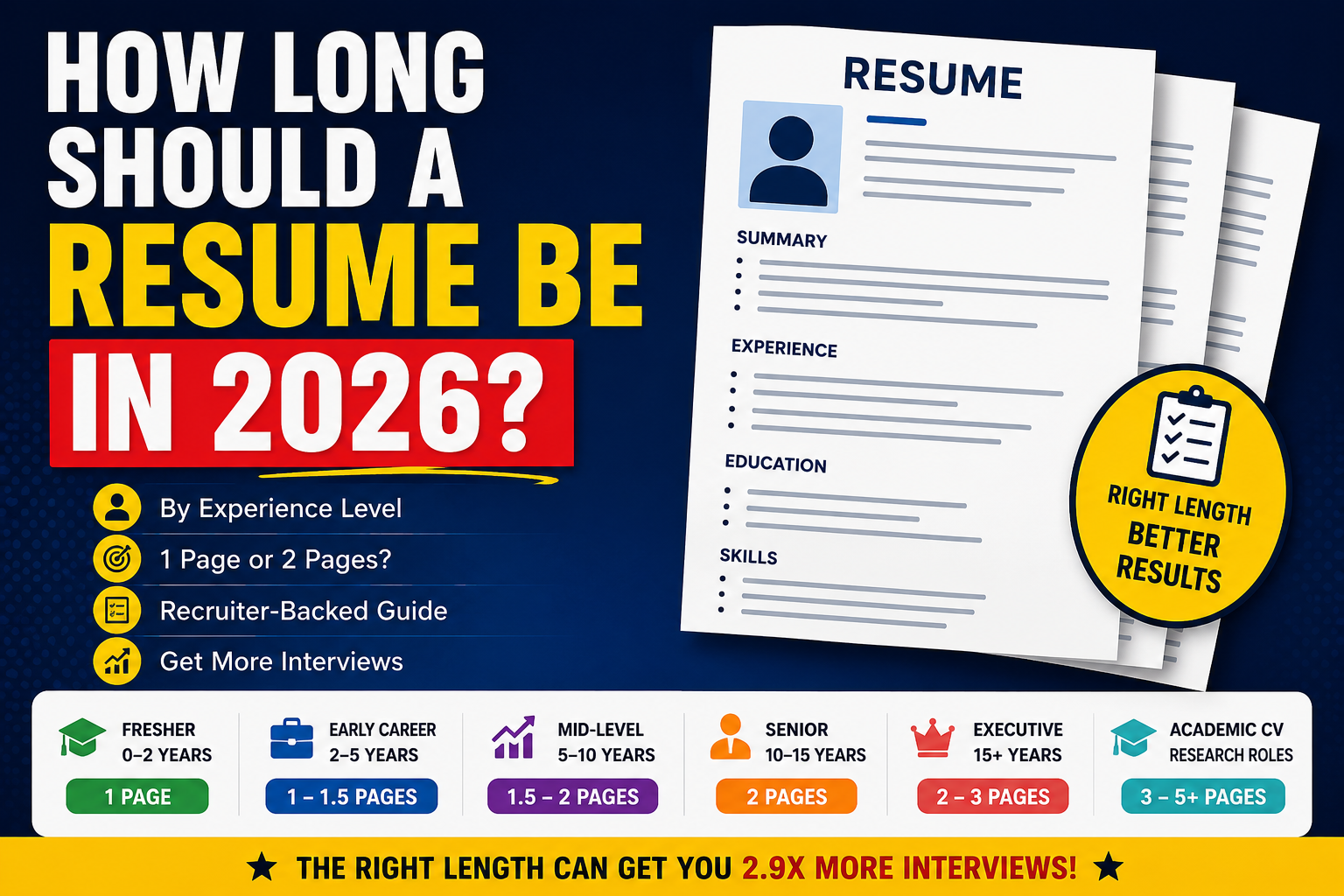
A 2025 ResumeGo study tracked 7,700 resumes submitted to real jobs. Resumes of the right length for the candidate’s experience got 2.9x more interviews than resumes that were too long or too short. Length matters — but the right length depends entirely on who you are.
In this article, I’ll tell you exactly how long your resume should be — based on your experience, industry, and career stage — and how to fit everything important on the right number of pages.
Resume Length by Experience Level — The Clear Guide
Stop guessing. Here’s what recruiters actually expect in 2026:
| Experience Level | Ideal Resume Length | Why |
|---|---|---|
| Fresher (0-2 years) | 1 page | Limited experience — one focused page proves clarity |
| Early career (2-5 years) | 1 page (strong) or 1.5 pages max | Still building — keep it tight |
| Mid-level (5-10 years) | 1.5-2 pages | Enough experience to justify a second page |
| Senior (10-15 years) | 2 pages | Multiple roles, achievements, and leadership experience |
| Executive (15+ years) | 2-3 pages | Extensive career — but still edited, not exhaustive |
| Academic CV | 3-5+ pages | Publications, research, conferences follow different rules |
The golden rule: Your resume should be as long as it needs to be — and not one line longer. Every sentence must add value. If a line doesn’t make a recruiter more likely to call you, delete it.
An HR manager at an MNC in Mumbai told me — “I see 2-page resumes from freshers with 6 months of internship experience. Half of page 2 is hobbies and declarations. If I have 200 resumes to screen, I’m spending 6 seconds on each. A bloated resume doesn’t get more attention — it gets less.”
Is One Page Enough for Freshers — Honest Answer
Yes. One page is not just enough — it’s ideal.
Here’s why. As a fresher, you have:
- One degree (or two if you count 12th)
- 8-12 skills
- 2-3 projects or internships
- Maybe 2-3 certifications
- A career objective
All of this fits comfortably on one page. If it doesn’t, you’re either including irrelevant information or using a bad format.
A BCA fresher in Bangalore sent me a 2-page resume. Page 1 had his name, a large photo, career objective, and education. Page 2 had skills, one project, hobbies (cricket, cooking, Netflix), a declaration, and his father’s name. I moved everything useful to one page — removed the photo, declaration, hobbies, and father’s name. His resume went from 2 weak pages to 1 strong page. Callbacks doubled in 3 weeks.
What a one-page fresher resume should contain:
| Section | Space Allocation |
|---|---|
| Header (name, contact, LinkedIn) | 2-3 lines |
| Career Objective | 2-3 lines |
| Education | 4-5 lines |
| Skills | 3-4 lines |
| Projects / Internships | 8-12 lines (2-3 entries) |
| Certifications | 2-4 lines |
That’s a full, strong one-page resume — without wasting space on anything irrelevant.
According to a 2025 Naukri recruiter survey, 82% of recruiters prefer one-page resumes for candidates with less than 3 years of experience. Going beyond one page as a fresher doesn’t show more value — it shows poor editing.
How to Fit Your Resume in One Page — Step by Step
You’ve written your resume. It spills to page 2 by 5-6 lines. You don’t want to cut content. Here’s how to fit everything on one page — without losing anything important.
Step 1: Remove everything that doesn’t add professional value.
Delete immediately — photo, hobbies, father’s/mother’s name, date of birth, marital status, blood group, full home address, declaration section, “References available upon request.” These collectively free up 6-10 lines. A fresher in Jaipur removed these items from her resume and instantly gained enough space for 2 additional project descriptions.
Step 2: Tighten your career objective to 2-3 lines.
If your objective is 5-6 lines, it’s a paragraph — not an objective. Cut it to the essentials: degree, top skills, one achievement or certification, target role. That’s it. “BCA graduate skilled in Python, SQL, and data visualization. Google certified. Seeking a junior analyst role.” Done in 2 lines.
Step 3: Reduce margins and adjust spacing.
Default Word margins are 1 inch (2.54 cm). Reduce to 0.6-0.7 inches on all sides. This alone gives you 15-20% more space. Line spacing at 1.0 or 1.1 instead of 1.5 or double. Section spacing of 6pt instead of 12pt between sections.
Step 4: Use a clean, single-column layout.
Two-column templates look modern but waste horizontal space. A single-column layout uses the full page width and fits more content naturally. Plus, ATS reads single-column layouts more reliably.
Step 5: Cut weak bullet points ruthlessly.
Read every bullet point. Ask — “Does this make a recruiter more likely to call me?” If the answer is no, delete it. “Attended team meetings regularly” — delete. “Completed all assigned tasks on time” — delete. “Built a REST API handling 500 daily requests using Spring Boot” — keep. Every bullet should show a skill, a tool, or a result.
When Your Resume Should Be Two Pages — And When It Shouldn’t
Two pages are justified when:
- You have 5+ years of experience across multiple roles
- You have measurable achievements at each role that are relevant to your target job
- You have significant certifications, publications, or patents
- The second page is full of substance — not padding
Two pages are NOT justified when:
- You’re a fresher stretching content to fill space
- Page 2 has hobbies, declarations, and references
- You’re repeating the same responsibilities across different jobs
- Half of page 2 is white space
A marketing professional in Delhi had 7 years of experience across 3 companies. Her resume was 1.5 pages. She tried to squeeze everything into 1 page — and lost critical achievements from her first two roles. I told her — “You’ve earned page 2. Use it.” She expanded to a clean 2 pages with detailed achievements at each company. Her next interview — the hiring manager referenced an achievement from page 2 specifically. Extra space used well is never wasted.
CV vs Resume — the length difference:
| Document | Length | Used For |
|---|---|---|
| Resume | 1-2 pages | Corporate jobs, private sector |
| CV (Curriculum Vitae) | 3-5+ pages | Academic, research, medical, government |
A CV includes publications, conferences, grants, and teaching experience — things a corporate resume doesn’t need. If you’re applying for a professor position or a research role, a multi-page CV is expected. For everything else — keep it to 1-2 pages.
Common Resume Length Mistakes
Mistake 1: Using large fonts and wide spacing to fill one page.
Your resume has 14pt body text, 1.5 line spacing, and 1.5-inch margins. It “looks” like one page — but contains the content of half a page. Recruiters notice immediately. It signals that you don’t have enough substance to fill even one page properly. Use 10-11pt body text, 1.0-1.1 line spacing, and 0.6-0.7 inch margins.
Mistake 2: Cramming 3 pages into 1 by shrinking everything.
The opposite problem. You reduce font to 8pt, eliminate all spacing, and create a wall of text that gives recruiters a headache. If your content genuinely needs 1.5 pages — use 1.5 pages. Readability matters more than hitting an arbitrary page count. A recruiter in Bangalore said — “I’d rather read a clean 1.5-page resume than squint at a crammed 1-page resume.”
Mistake 3: Adding a third page for senior roles.
Unless you’re a C-suite executive with 20+ years or an academic with publications, 3 pages is almost never needed. A 12-year experienced developer doesn’t need 3 pages. Edit ruthlessly — keep only the last 10-12 years of relevant experience. Older roles can be summarized in 1-2 lines. Your most recent 2-3 roles deserve the most detail.
Mistake 4: Treating resume length as a one-time decision.
Your resume length should change as your career grows. A 1-page resume at 22 years old should evolve into a 1.5-page resume by 28 and a 2-page resume by 35. Review and restructure your resume every year. What was relevant 3 years ago might be filler today. Update length as your career expands.
Frequently Asked Questions
Q1: Is one page resume enough for freshers?
Yes — and it’s preferred. 82% of recruiters expect one-page resumes from candidates with less than 3 years of experience. Your degree, skills, projects, and certifications fit comfortably on one page. If your fresher resume exceeds one page, you likely have irrelevant content (hobbies, declarations, photo) that should be removed.
Q2: Can a resume be more than 2 pages?
Only in specific cases — academic CVs (professors, researchers), executive roles with 20+ years of experience, or government applications that specifically request detailed CVs. For 95% of corporate job applications in India, 1-2 pages is the maximum. Anything beyond that signals poor editing, not rich experience.
Q3: How to fit a resume in one page?
Remove non-essential items (photo, hobbies, declaration, full address). Tighten your objective to 2-3 lines. Reduce margins to 0.6-0.7 inches. Use 10-11pt font with 1.0-1.1 line spacing. Cut weak bullet points. Use a single-column layout. These adjustments alone save 30-40% space without losing any meaningful content.
Q4: Does resume length actually matter to recruiters?
Yes. Resumes of appropriate length for the candidate’s experience level receive 2.9x more interview calls. Too long signals inability to prioritize. Too short signals lack of substance. Match your length to your experience — 1 page for 0-5 years, 2 pages for 5-15 years.
Q5: What is the difference between CV and resume length?
A resume is 1-2 pages, focused on skills and achievements for corporate jobs. A CV (Curriculum Vitae) is 3-5+ pages, including publications, research, conferences, and teaching — used for academic, research, medical, and some government positions. In India, most private sector jobs expect a resume, not a CV.
Your Resume Length Should Match Your Career — Not Your Ego
Here’s the final truth — a 3-page resume doesn’t make you look experienced. It makes you look like you can’t edit. A half-page resume doesn’t make you look focused. It makes you look empty.
One page for freshers. Two pages for experienced professionals. Every line earning its space. That’s the formula.
Open your resume tonight. Count the pages. Count the lines that actually matter. Remove everything that doesn’t help you get the call. Keep everything that does.
The right resume isn’t the longest. It’s the one that says the most in the least space. 💪