The interview is almost over. You’ve answered everything well. Then the interviewer says — “Do you have any questions for us?” You smile and say — “No, I think you’ve covered everything. Thank you.”
You just made a mistake. A big one.
That “any questions for us?” moment isn’t a formality. It’s your final test. And saying “no” tells the interviewer — “I’m not curious enough to ask anything about the job I’m about to spend 8 hours a day doing.”
According to a 2025 Indeed India survey, 89% of interviewers said they judge candidates negatively when they don’t ask any questions at the end. It signals low interest, poor preparation, or both.
In this article, I’ll give you 10 smart questions you can ask in any interview — plus the questions you should never ask — so your last impression is just as strong as your first.
Why Asking Questions Actually Helps You Get Selected
Most candidates think the interview ends when the interviewer stops asking. It doesn’t. When they say “Do you have questions?” — the interview is still on. They’re still evaluating you.
What asking good questions signals:
| What You Do | What the Interviewer Thinks |
|---|---|
| Ask about the role and expectations | “This person wants to understand the job properly” |
| Ask about team and culture | “This person cares about fit, not just salary” |
| Ask about growth opportunities | “This person is thinking long-term” |
| Ask nothing | “This person isn’t interested enough” |
| Ask only about salary and leaves | “This person only cares about what they get” |
A hiring manager at Wipro Chennai told me — “The questions a candidate asks tell me more about them than their answers to my questions. When someone asks about the team structure and first-month expectations, I know they’re genuinely planning to work here — not just collecting offers.”
Does asking questions help in getting selected? Directly — no. Your technical skills and interview answers matter most. But indirectly — absolutely. Good questions create a positive final impression. And when two candidates are equally qualified, the one who showed genuine curiosity often gets the edge.
A fresher in Pune asked the interviewer — “What’s the biggest challenge the team is currently facing?” The interviewer paused, then had a 5-minute conversation about their project bottleneck. The fresher later told me — “It stopped feeling like an interview and started feeling like a real conversation.” She got the offer. Her question turned a formal evaluation into a genuine connection.
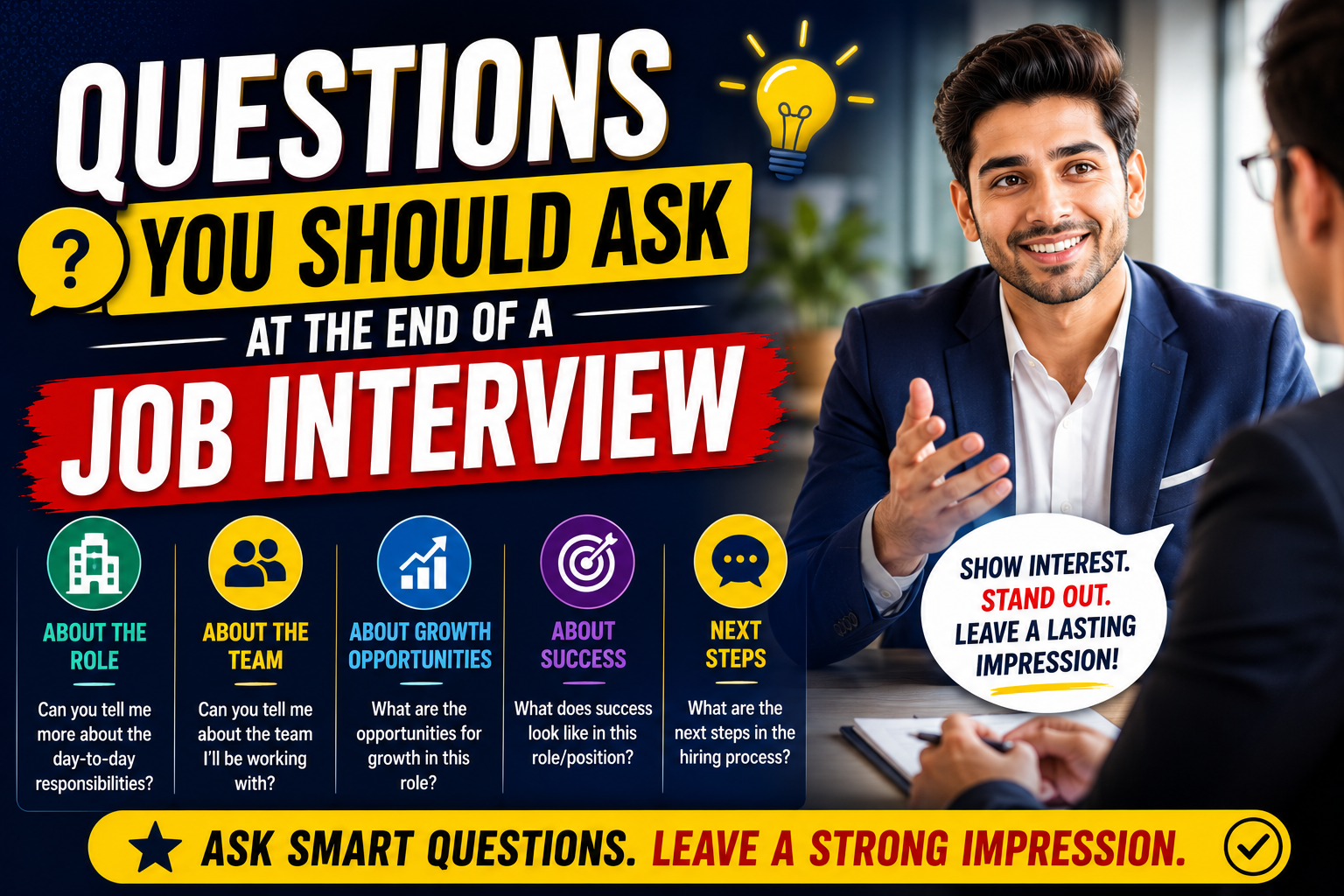
10 Smart Questions to Ask the Interviewer — Ready to Use
About the Role (Best for Any Interview Round)
Q1: “What does a typical day or week look like in this role?”
This is the safest and most impressive question you can ask. It shows you’re already thinking about doing the work — not just getting the job. The answer also helps you decide if the role actually matches what you expected.
Q2: “What are the key expectations for this role in the first 3 months?”
This tells the interviewer — “I’m already planning how to deliver.” It also gives you clarity on what success looks like before you even start. A marketing fresher in Delhi asked this question and discovered the first priority was setting up Google Analytics — a skill she already had. She mentioned that immediately, strengthening her candidacy in the final minute.
Q3: “What’s the biggest challenge someone in this role typically faces?”
This question shows maturity. You’re not asking if the job is easy — you’re preparing for what’s hard. The answer also reveals real job conditions that the job description might not mention.
About the Team and Culture
Q4: “Can you tell me about the team I’ll be working with?”
You’ll spend 40+ hours a week with these people. Knowing the team size, structure, and dynamic matters. It also shows the interviewer you value collaboration — not just individual work.
Q5: “How would you describe the company culture here?”
This question works especially well in HR rounds. It signals that you’re evaluating cultural fit — which means you’re thinking seriously about staying long-term. Companies want people who fit in and stay — not job-hoppers who leave in 6 months.
Q6: “How does the team handle feedback and performance reviews?”
This shows you’re open to feedback and interested in growth systems. A candidate who asks about feedback is perceived as someone who wants to improve — which is exactly the kind of person every manager wants on their team.
About Growth and Development
Q7: “What does the career growth path look like for this role?”
Every candidate wonders about growth — but most don’t ask. This question tells the interviewer you’re thinking beyond the first year. It also gives you real information about promotion timelines and advancement opportunities.
Q8: “Does the company support learning — like certifications, courses, or training programs?”
In 2026, upskilling matters. This question shows you’re committed to continuous learning. Many Indian companies — TCS, Infosys, Deloitte, Flipkart — offer learning budgets. If they do, this question helps you discover that benefit early.
For Specific Rounds
Q9 (For Technical Rounds): “What technologies or tools is the team currently exploring or planning to adopt?”
This shows technical curiosity. It also helps you understand if the team uses modern or outdated technology — which affects your career growth. A developer in Bangalore asked this and learned the team was migrating to React.js — his strongest skill. He highlighted that immediately.
Q10 (For Final/HR Round): “What is the typical timeline for the next steps in the hiring process?”
This is practical and professional. It shows you respect their process and want to plan accordingly. It also gives you a clear expectation — instead of waiting weeks without knowing what’s happening.
Questions You Should NEVER Ask the Interviewer
Some questions are genuine — but asking them at the wrong time destroys your impression.
| Never Ask This | Why It Hurts You |
|---|---|
| “What does the company do?” | Shows you didn’t research — basic homework failure |
| “What is the salary for this role?” (in first round) | Salary discussion belongs in HR/final round — not technical |
| “How many leaves do I get?” | Signals you’re already planning to not work |
| “Can I work from home?” (first question) | Makes it seem like WFH matters more than the job |
| “Did I get the job?” | Puts the interviewer in an awkward position |
| “Do you check social media of candidates?” | Raises suspicion about what’s on your profiles |
| “I don’t have any questions” | Signals low interest or poor preparation |
| “How quickly can I get promoted?” | Sounds entitled — ask about growth path instead |
The salary and WFH rule: These are valid concerns. But timing matters. Ask about salary in the HR round or during offer discussion — not in the first technical round. Ask about WFH policy after you’ve shown strong interest in the role itself — not as your first question.
A fresher in Hyderabad asked “How many casual leaves are there?” as his only question. The HR manager later told me — “He seemed more interested in leaves than in the job. We went with someone who asked about the team and training opportunities.” One wrong question overshadowed a good interview.
A marketing candidate in Mumbai asked “Do you monitor employee screens during WFH?” as her question. The interviewer’s impression shifted immediately from positive to suspicious. She didn’t get a callback. Some questions — even if valid — should be saved for after you receive the offer, when you have more leverage and context.
How Many Questions Should You Ask — And How to Deliver Them
The ideal number: 2-3 questions.
One question feels minimal. Five questions turns the end into another interview — with you interrogating the interviewer. Two to three questions is the sweet spot.
How to deliver them:
Step 1: Prepare 4-5 questions before the interview. Write them in your notebook. You won’t ask all of them — some might get answered during the interview naturally. Having extras means you always have something to ask.
Step 2: Listen during the interview for answered questions. If the interviewer already explained the team structure, don’t ask about it again. Cross it off mentally and pick your next prepared question.
Step 3: Ask naturally — not like reading from a list. Say “I was curious about…” or “I’d love to understand…” instead of mechanically rattling off questions. A conversational tone makes the exchange feel genuine.
Step 4: Listen to their answers actively. Nod. React. Ask a brief follow-up if something is interesting. This shows you’re genuinely engaged — not just checking a box.
A fresher in Chennai prepared 5 questions. During the interview, 2 were already answered. She asked the remaining 3 — about the team, first-month expectations, and learning support. The interviewer spent 10 minutes answering enthusiastically. She told me later — “Those 10 minutes felt like the interviewer was selling the job to me. The dynamic completely shifted.” That’s the power of good questions.
Frequently Asked Questions
Q1: Is it okay to ask questions at the end of an interview?
Not just okay — it’s expected. 89% of interviewers judge candidates negatively for not asking any questions. Asking 2-3 thoughtful questions shows genuine interest, preparation, and curiosity. Always prepare at least 4-5 questions beforehand so you have options even if some get answered during the interview.
Q2: What questions should I never ask the interviewer?
Never ask “What does the company do?” (shows no research), salary questions in the first round, how many leaves you get, or “Did I get the job?” Also avoid asking about WFH as your first or only question. Save salary and benefits discussion for the HR round or offer stage when it’s appropriate.
Q3: How many questions should I ask at the end of an interview?
Two to three is ideal. One feels like you’re checking a box. More than four can feel like you’re interrogating the interviewer. Prepare 4-5 in advance — some will get answered during the conversation naturally. Ask the remaining 2-3 that feel most relevant to the discussion.
Q4: What if the interviewer says there’s no time for questions?
Respect their time. Say — “No problem. I did want to ask about [one brief question] — would it be okay to follow up via email?” This shows you had questions prepared and you’re respectful of their schedule. Most interviewers appreciate this.
Q5: Does asking questions actually help in getting selected?
It helps indirectly. Good questions won’t override weak technical answers. But when two candidates are equally qualified, the one who asked thoughtful questions about the role and team leaves a stronger final impression. It shows genuine interest — and interest is a selection factor, especially in HR rounds.
The Last 5 Minutes Decide More Than You Think
Here’s what most candidates miss — the interview doesn’t end when the interviewer stops asking. It ends when you walk out of the room. And your final impression is shaped by what you ask — not what you answered.
Write down 4-5 questions tonight. Pick questions about the role, the team, and growth — not salary and leaves. Practise asking them naturally.
When the interviewer says “Do you have any questions?” — smile and say “Yes, I have a couple.” That confidence in the final moment tells them — this person is serious, prepared, and genuinely interested.
Ask smart questions. Leave a lasting impression. 💪