
The interview is going well. You’ve answered “tell me about yourself” confidently. You’ve handled the strengths and weaknesses question. Then the interviewer leans forward — “So, why should we hire you?”
Your mind goes blank. You want to say something impressive. Instead, you say — “Because I’m hardworking and I’ll give my best.” The interviewer nods politely. But you can see it — they’ve heard that answer 500 times today.
This question isn’t a personality test. It’s a sales pitch. The interviewer is asking — “Give me one clear reason to pick you over the other 20 candidates waiting outside.”
In this article, I’ll give you the exact formula to answer this question — with ready-to-use sample answers for freshers, experienced professionals, and specific industries. Plus the things you should never say.
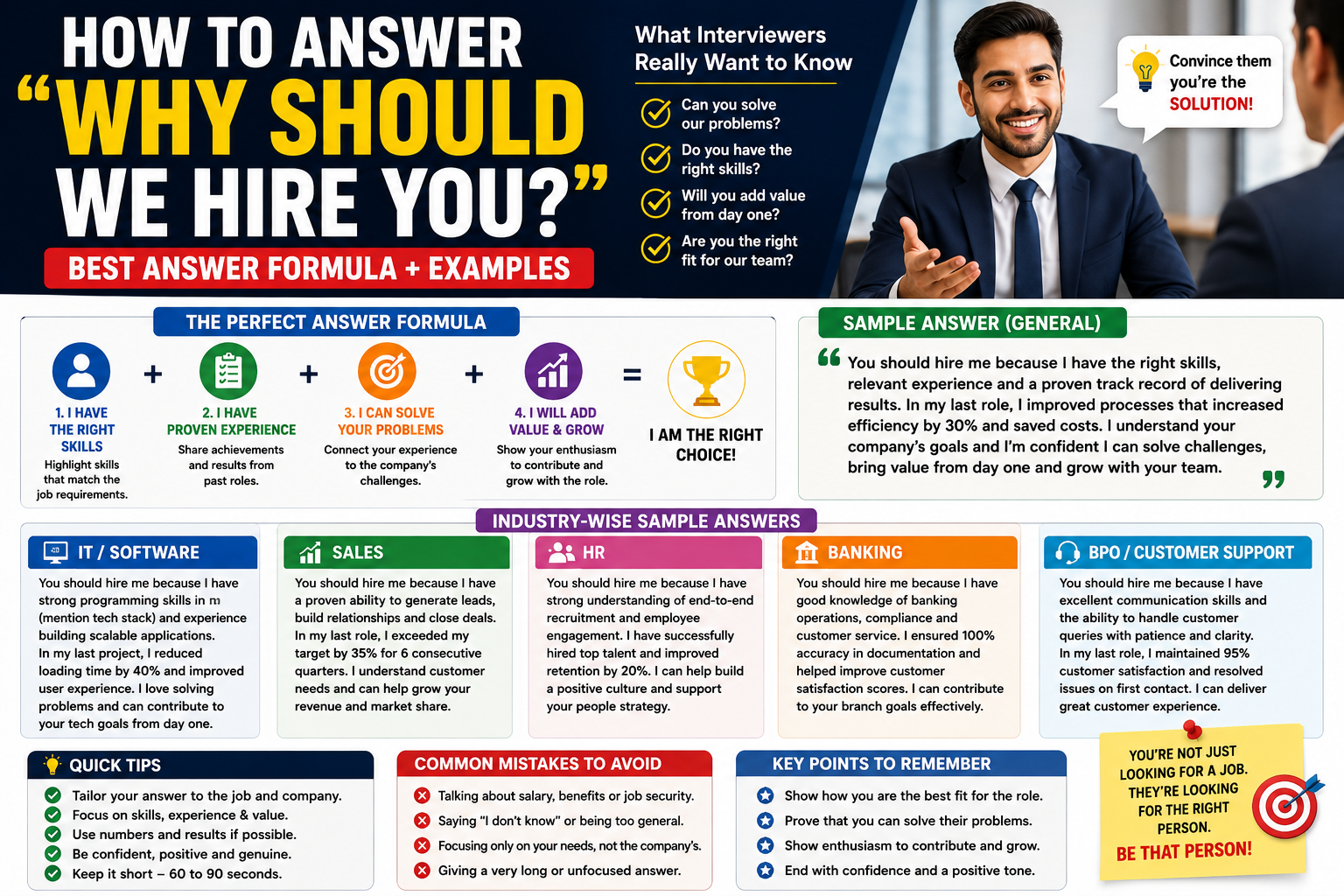
The Formula — How to Structure Your Answer in 3 Parts
Most candidates answer this question with vague adjectives. “I’m dedicated. I’m passionate. I’m a fast learner.” These words describe 100% of candidates. They differentiate 0%.
Use this 3-part formula instead:
| Part | What to Say | Time |
|---|---|---|
| 1. Match | Connect your skills to the job requirement | 20-25 seconds |
| 2. Proof | Give one specific achievement or example as evidence | 20-25 seconds |
| 3. Value | Explain what you’ll bring to the team from day one | 15-20 seconds |
Total: 60-75 seconds. Short. Specific. Convincing.
The logic: The interviewer has a problem — they need someone to fill a role. Your answer should say — “I understand what you need. Here’s proof I can deliver. Here’s what you’ll get if you hire me.”
A hiring manager at Infosys Pune explained it perfectly — “I don’t want to hear why you want the job. I want to hear why the job needs you. The best answers connect the candidate’s skills directly to our requirements — not generic statements about passion.”
According to a 2025 LinkedIn India Talent Report, 76% of recruiters said the “why should we hire you” answer is the single most influential response in deciding between two equally qualified candidates. It’s the tiebreaker question. Get it right and you win the tie.
Why Should We Hire You — Freshers Answer by Industry
IT / Software Fresher
“You’re looking for a junior developer who can work with Java and databases. I’ve spent the last 2 years building projects in Java and MySQL — including a student management system that handles 500+ records with real-time search functionality. I’ve also completed the AWS Cloud Practitioner certification, so I understand cloud basics. I can start contributing to your development team from day one because I’ve already worked with the exact tech stack mentioned in your job description.”
Why it works: Directly references the job requirement. Proves ability with a specific project. Shows extra initiative through certification. Ends with a clear value statement.
Sales / Business Development Fresher
“This role needs someone who can handle outbound client outreach and build new accounts. During my MBA internship at XYZ in Pune, I did exactly that — I contacted 120+ prospects over 2 months, converted 18 into active leads, and 6 of those became paying clients. I’m comfortable with cold outreach, follow-ups, and CRM tools. I can bring that same energy and conversion rate to your sales team.”
HR Fresher
“You need an HR executive who can handle recruitment and onboarding. During my internship at a 400-employee IT company, I screened 300+ resumes, coordinated 45 interviews, and helped onboard 12 new hires — including documentation, induction scheduling, and buddy assignments. I also understand HRIS tools — I used Keka for attendance and leave management. I’m ready to handle your recruitment pipeline independently.”
Bank Job Fresher
“This role requires someone with strong finance fundamentals and customer handling ability. I’m a B.Com graduate with IIBF certification in banking awareness. During my internship at a cooperative bank, I processed 200+ KYC documents and assisted customers with account queries daily. I understand banking compliance, customer documentation, and service standards. I can contribute to your branch operations from the first week.”
BPO / Customer Service Fresher
“You need someone who can handle customer calls professionally and resolve issues quickly. I worked as a part-time telecaller during college — I handled 60+ calls daily with a 92% customer satisfaction rating and 15% upsell conversion rate. I’m fluent in English and Hindi, calm under pressure, and comfortable with CRM systems. I can deliver consistent quality on your support line from day one.”
A fresher in Delhi used the IT answer above — customized with her own project details. The interviewer later told her — “You’re the first candidate today who actually referenced our job description in the answer. Everyone else talked about themselves.” She got the offer. The answer wasn’t about her. It was about what the company needed.
Why Should We Hire You — Experienced Professional Answers
IT Professional (3-5 Years)
“You need a senior developer who can lead backend development and improve system performance. That’s exactly what I’ve been doing for 4 years at my current company. Last quarter, I led a database optimization project that reduced query execution time by 55% — which directly improved our app’s load speed for 20,000 daily users. I also mentor 2 junior developers. I bring both technical depth and team leadership — which matches what this role requires.”
Marketing Professional (3-5 Years)
“You’re scaling your performance marketing and need someone who can manage large budgets across multiple channels. At my current company, I manage ₹10 lakh monthly ad spend across Google, Meta, and YouTube — and I’ve improved ROAS from 2.2x to 3.8x over 8 months. I also set up our marketing attribution system from scratch. I can bring that same data-driven approach to scale your campaigns profitably.”
Career Change Candidate
“I know my background is in IT, not product management. But what product management needs — understanding user problems, coordinating cross-functional teams, and data-driven decision making — is exactly what I’ve done for 6 years as a project lead. I’ve managed 4 product releases, worked with developers, designers, and business teams, and used analytics to prioritize features. I’ve also completed the Google Project Management and Udemy Product Management certifications. My IT experience gives me a technical edge most PMs don’t have.”
What NOT to Say — Common Mistakes That Kill Your Answer
Mistake 1: “Because I need this job.”
Your financial situation doesn’t answer the question. The interviewer wants to know what you bring to the table — not what you take from it. A fresher in Lucknow said “Because I really need a job and my family is depending on me.” The interviewer felt sympathy — but hired someone who showed how they’d add value. Interviews reward capability, not sympathy.
Mistake 2: “Because I’m hardworking and passionate.”
Every candidate says this. Literally every single one. It’s the most common answer in Indian interviews — and the least effective. Without proof, “hardworking” is just a word. Replace it with evidence — “I completed 3 certifications while working full-time” proves hard work without using the word.
Mistake 3: “Because I’m a quick learner.”
This actually works against freshers. It tells the interviewer — “I don’t know the skills yet, but I’ll learn.” The interviewer wants someone who already has the foundational skills. Instead say — “I’ve already learned Java, SQL, and Git through my college projects. I can start contributing while continuing to learn advanced concepts on the job.” This shows capability plus growth mindset.
Mistake 4: Giving a 3-minute monologue.
If your answer crosses 90 seconds, you’ve lost the interviewer. Long answers dilute impact. A 2025 Glassdoor India study found that answers between 60-90 seconds received the highest interviewer ratings for this question. Anything longer and the score dropped. Be concise. Say less. Mean more.
Mistake 5: Repeating your resume.
“I have a B.Tech from XYZ college. I know Java, Python, and SQL. I did an internship at ABC company.” The interviewer has your resume in front of them. They don’t need you to read it back. Instead, connect your resume highlights to their specific needs. “Your job description mentions building REST APIs — I built 3 production-ready APIs during my internship” is 10x better than listing your qualifications.
Mistake 6: Being humble to the point of weakness.
“I may not be the most qualified, but I’ll try my best.” This practically tells the interviewer — “Don’t hire me.” Confidence doesn’t mean arrogance. It means clearly stating what you can do without apologizing for it. “I have the technical skills this role needs and I’ve already proven them through my projects” is confident and factual.
Frequently Asked Questions
Q1: What is the best answer for why should we hire you?
The best answer connects your skills directly to the job requirements, provides one specific achievement as proof, and ends with what value you’ll bring from day one. Use the Match-Proof-Value formula. Keep it 60-75 seconds. Make it about what the company gets — not what you want.
Q2: How to answer why should we hire you with no experience?
Replace work experience with college projects, internships, certifications, and extracurricular achievements. “You need someone skilled in Python and SQL. I built a data analysis project using both during college and completed Google’s Data Analytics certificate. I’m ready to contribute from week one.” Projects are your proof when you don’t have employment history.
Q3: What should you NOT say when answering this question?
Never say “because I need a job,” “because I’m passionate,” or “because I’m a quick learner” without proof. Don’t repeat your resume word for word. Don’t give a 3-minute answer. Don’t be apologetic about your qualifications. Every sentence should add a reason to hire you — not a reason to feel sorry for you.
Q4: How to make your answer unique among other candidates?
Reference the specific job description — mention exact skills or tools they’ve listed. Add a number — project scale, budget managed, percentage improved. Most candidates give generic answers. The moment you say something specific to this company and this role, you stand apart from everyone else in the waiting room.
Q5: Can I ask a question when answering why should we hire you?
You can briefly reference the role requirements — “Based on what you’ve described about this role…” — but don’t turn your answer into a question session. This is your moment to sell yourself. Ask your questions during the “Do you have any questions for us?” section at the end. Keep the focus on demonstrating your value.
They’re Not Asking About You — They’re Asking About Themselves
Here’s the secret most candidates miss — “Why should we hire you?” is not a question about you. It’s a question about the company’s needs. They have a problem — an empty chair, a project without resources, a team missing a skill. Your answer should say — “I understand your problem. Here’s proof I can solve it.”
Write your answer tonight. Read the job description first. Find the 2-3 key requirements. Match them with your skills and one achievement. Practise it aloud 5 times.
The candidates who get hired aren’t always the most qualified. They’re the ones who make the interviewer think — “This person understands exactly what we need.”
Show them what they’ll get. Not what you want. 💪